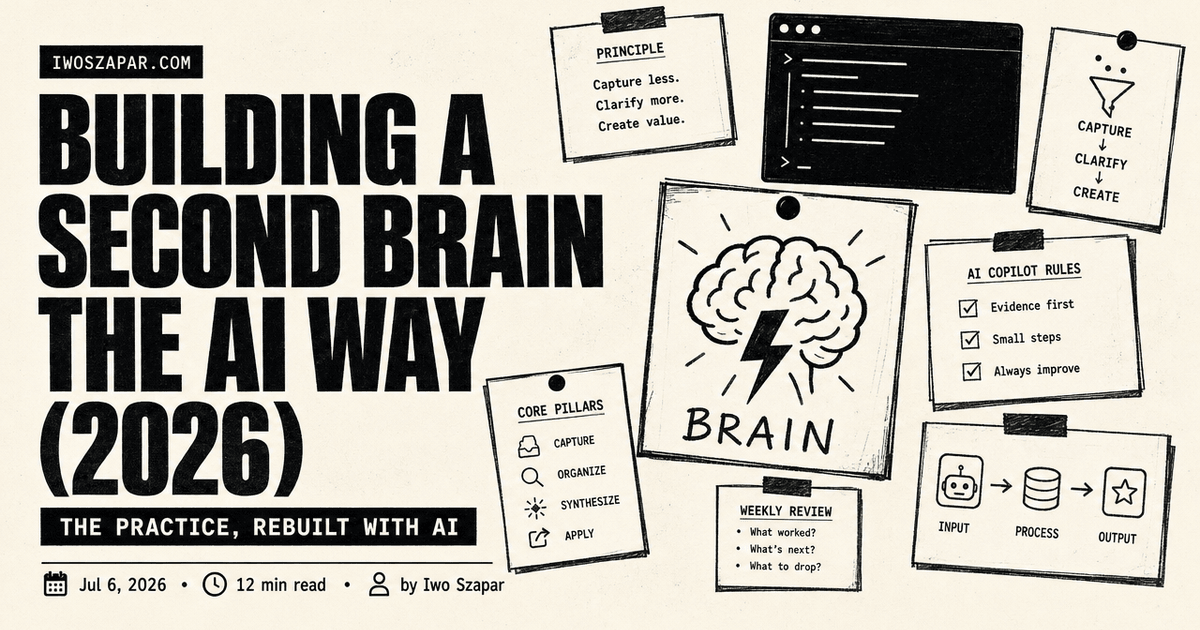
Building a Second Brain the AI Way (2026)
The practice, rebuilt with AI
Tiago Forte named the thing. His 2022 book, Building a Second Brain, gave a generation a practice: capture what catches your attention, organize it so you can act on it, distill it down, and express it as work you actually ship. The idea holds up. Your head is for having thoughts, not storing them, and an external system carries the load.
What has changed since he wrote it is who does the labor. Forte's practice asked you to be the one capturing, filing, and pruning by hand. I did that for years, and I was bad at it. Every second brain I built the old way turned into a graveyard the week I got busy. So this is the version I run now: building a second brain where an AI assistant with persistent memory does the capturing and the filing for me, and remembers across every session.
This guide is a 2026 rebuild of the practice, not a re-explanation of Forte's book. I will credit what came from him, be clear about what is new, and walk the AI way step by step so you can run it yourself. This is commentary and a rebuild, not anything endorsed by or affiliated with Forte.
What building a second brain means the AI way
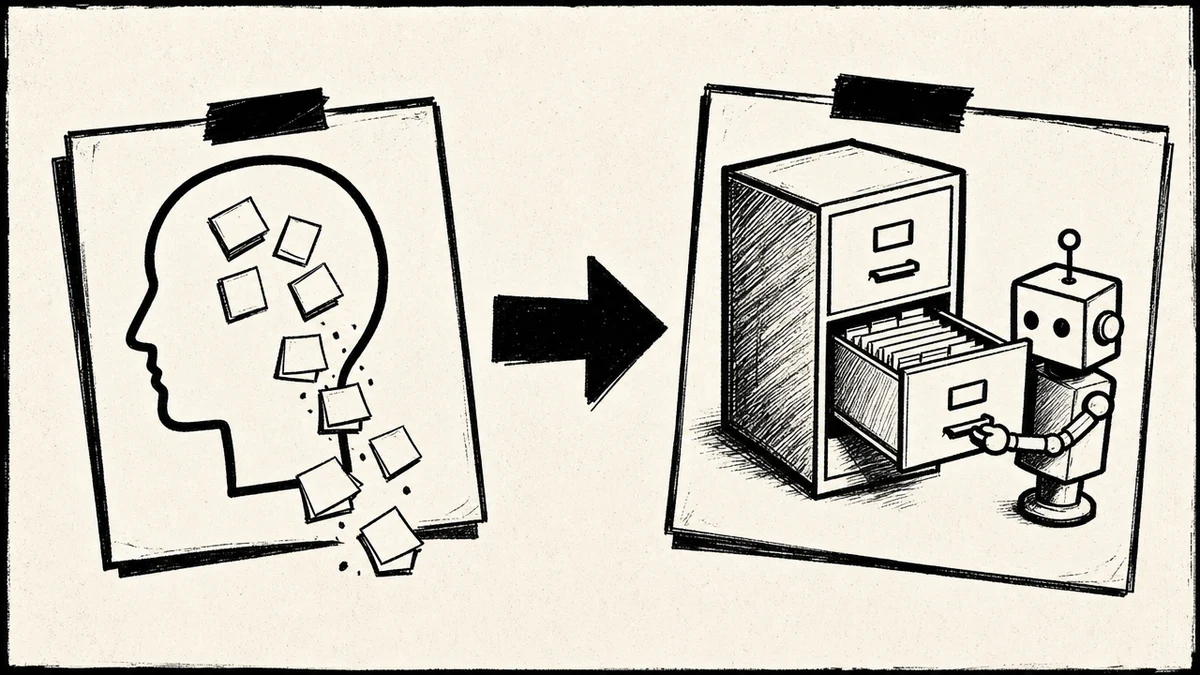
A second brain is an external system that holds your knowledge so your actual brain can stay free for thinking. That definition is Forte's, and it is still correct. The disagreement is not about what a second brain is for. It is about who maintains it.
The old way put you in every loop. You clipped the article, you filed it in the right folder, you came back later and pruned the notes that went stale. The system only worked if you kept working it, which is exactly why most of them die.
The AI way moves that labor onto an assistant. You still decide what good looks like and you still review the output. But the capturing, the filing, and the recall happen without you being the librarian. The result is not a tidier vault. It is a second brain that maintains itself while you do the work it was supposed to support.
If you already know you will not keep filing by hand, that is worth being honest about rather than fighting. Iwo's Second Brain runs the capturing and the memory for you on Iwo's MemoryOS, so the vault does not become a graveyard the week you get busy. The zero-risk way to start is the free MemoryOS Health Check, which scores your current setup with no commitment.
If you want the plain, tool-agnostic version of what an AI second brain is before you go deeper here, I wrote the AI second brain guide as the concept pillar. This post is the practice pillar: how the CODE discipline itself gets rebuilt when an AI runs it.
Who was Tiago Forte and what is the CODE method?
Tiago Forte is a productivity writer and teacher, and Building a Second Brain is his book and his course. Its core is a four-step practice he calls CODE: Capture, Organize, Distill, Express. It is a genuinely good mental model, and it is worth reading in his own words through his introduction to the method.
Here is the practice as he taught it, in one line each.
- Capture. Keep what resonates. Save the idea, the quote, the passage, before it evaporates.
- Organize. File what you saved by how actionable it is, not by topic, so you can find it when a project needs it.
- Distill. Boil long material down to the parts that matter, so future-you can use it in seconds.
- Express. Turn what you have kept into output, notes into drafts, drafts into shipped work.
Forte pairs CODE with an organizing system called PARA, four buckets: Projects, Areas, Resources, Archives. PARA is the filing scheme, CODE is the workflow that flows through it. If you want the buckets explained properly, that is the job of the PARA method guide, and the confusion between the method and the book is untangled in PARA method vs Building a Second Brain. I am not going to re-explain them here. My job in this post is what happens to CODE when an AI runs each step.
The CODE practice, rebuilt with an AI assistant
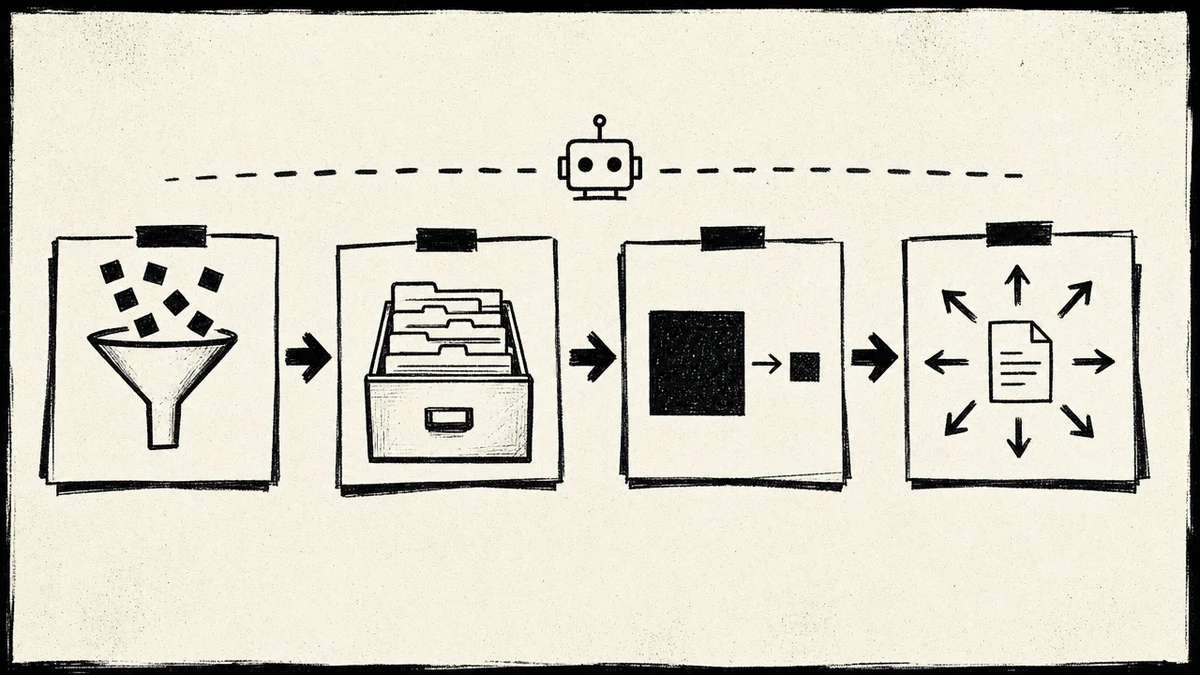
CODE was designed for a human with a notes app. Rebuild each step for an AI assistant with memory, and every one of them gets cheaper and more reliable, because the tax that killed the manual version was always the human doing it consistently.
How does AI change Capture?
Capture was the step I failed most. I would finish a good conversation, think "I should write that down," and not. The AI way removes the "I should" entirely. The assistant notices what is worth keeping from a working session and writes it down itself, into a store it controls.
In practice I give the assistant a standing rule: when we make a decision, learn a stable fact, or leave something unfinished, save it. Then I just work. Capture stops being a discipline I have to sustain and becomes a byproduct of talking to the assistant. That is the single biggest reason the AI version does not rot.
How does AI change Organize?
Forte's Organize step asks you to file by actionability, which is smart and also work. The AI way files for you. When the assistant captures a decision, it stores it as a decision. When it captures a stable truth about a client, it files it as a fact. You are not dragging cards between folders.
The trick is to give the assistant a small set of typed surfaces to file into rather than one undifferentiated pile. Decisions, facts, open loops: a handful of categories the assistant understands beats a deep folder tree nobody tends. The applied, PARA-shaped version of this, wiring Projects, Areas, Resources, and Archives to an assistant, is its own build, and I walk it in how to use PARA in an AI second brain.
How does AI change Distill?
Distill is where AI is almost unfairly good. Forte's insight was that raw notes are useless until you condense them to the actionable core. An assistant does that on demand: hand it a long transcript, a meeting, a research dump, and ask for the decisions, the open questions, and the facts worth keeping. It returns the distilled version and files it, so the long source and the short summary both live in the store.
The difference from doing it yourself is that distillation stops being a chore you defer forever. You never again have a folder of articles you meant to summarize and never did.
How does AI change Express?
Express is the payoff, and it is where the memory earns its keep. When I ask the assistant to draft something, a follow-up, a proposal, a section of a post, it does not start from a blank page. It recalls the relevant decisions, facts, and open loops first, then writes from my real context in my voice. Forte's Express step was you assembling your intermediate packets by hand. The AI way is the system assembling them for you, because it captured and organized them along the way.
The memory layer Forte never had
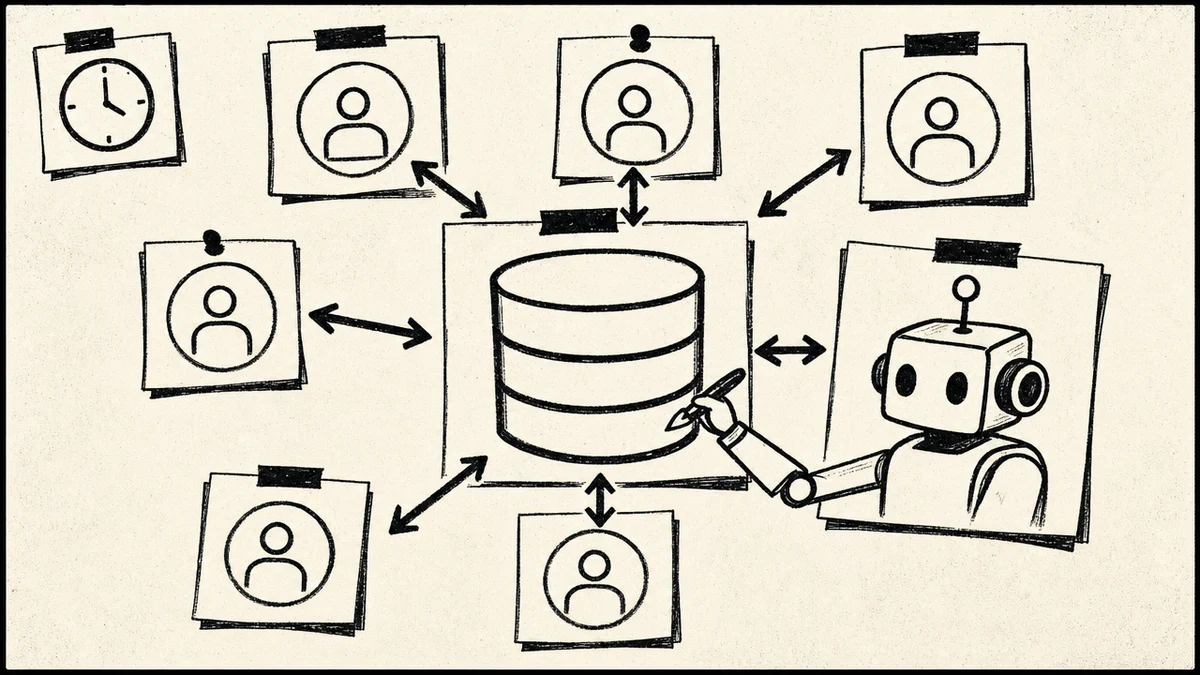
Here is the part that is genuinely new, not just automated. Forte's practice had no persistent memory across sessions, because in 2022 the tools did not either. Every step assumed a human returning to a static vault.
An AI second brain adds a memory layer: a store the assistant reads at the start of every session and writes to as it works, so context carries forward instead of resetting. This is the piece that turns CODE from a practice you perform into a system that runs. Capture writes to the memory layer. Organize is the memory layer's typed structure. Distill lands its summaries there. Express reads from it before writing.
In 2026 the standard way to give an assistant that store is an MCP memory server. MCP, the Model Context Protocol, is the connection that lets an AI client like Claude reach an external tool, and a memory server is a tool whose whole job is holding and returning your knowledge. The assistant gets functions, write this fact, find what we decided about this client, list open loops, and calls them like any other tool. If the mechanics interest you, the second brain MCP explainer goes under the hood.
The build I run is Iwo's Second Brain on Iwo's MemoryOS, an MCP memory server that ships the store, the typed surfaces, and the capture-and-recall protocol as a template. It works across Claude Code, Claude Cowork, Claude Desktop, Cursor, and Windsurf, so the same brain follows me between clients. The data sits in a local database on my machine, which matters once the brain holds client notes and private decisions.
How to build your second brain the AI way
You can stand up a working version in an afternoon. Here is the order I would follow, mapped to CODE so you can see the practice underneath.
- Connect a memory store the assistant can write to (this powers Organize). Set up an MCP memory server so the assistant has read and write functions, not a doc it can only read. Without a writable store there is no AI second brain, just a chatbot with a good memory of the last few minutes.
- Write one short memory file (this teaches Capture and recall). A single file the assistant loads every session: who you are, what you are working on this quarter, how you write, and two rules, capture decisions and facts and open loops as we go, and recall before you act. Keep it short. It points to the store, it is not a copy of it. The full setup on MemoryOS is in the persistent memory guide.
- Do one real session and let it capture and distill. Work normally. Ask it to summarize a long input and file the result. Correct anything it miscategorizes once, and it learns the pattern.
- Test recall on a fresh session (this proves Express). Start clean and ask for something that depends on last session's notes. If it pulls the right context without you pasting anything, the loop is closed and Express will draft from real memory.
- Let upkeep run. A second brain rots when facts go stale and decisions get superseded. Push that maintenance onto the store so recall returns the current version, not the outdated one.
If wiring each piece by hand is not how you want to spend the afternoon, that is what the agent-run second brain build covers end to end, and the packaged Second Brain template starts you at step three.
Second brain the AI way vs the classic method
The two are not enemies. The AI way is the classic practice with the labor moved onto the system and a memory layer bolted on. This is the side-by-side I give people deciding whether to rebuild.
| Dimension | Classic Building a Second Brain | Second brain the AI way |
|---|---|---|
| Capture | You save what resonates by hand | The assistant captures from your sessions |
| Organize | You file by actionability | The assistant files into typed surfaces |
| Distill | You summarize long material yourself | The assistant distills on demand and files it |
| Express | You assemble your notes into output | The assistant recalls context and drafts from it |
| Memory across sessions | None, the vault is static | A persistent memory layer the assistant reads and writes |
| Who maintains it | You, until you get busy | The system, with your review |
The honest caveat: the AI way asks for a little setup the classic method does not, connecting a store and writing a memory file. In exchange you stop being the librarian. For a system I actually kept using, that trade was not close.
Mistakes that turn the AI way back into a graveyard
I have made all of these, and each one quietly recreates the old rot.
- Using a read-only store. If the assistant cannot write back, you are still the data-entry clerk and Capture dies the first busy week. The store has to be writable by the assistant.
- One giant notes blob. Skip the typed surfaces and Organize collapses, recall returns noise, and you stop trusting it. Give the assistant decisions, facts, and open loops.
- No recall rule. If the memory file never tells the assistant to check memory first, Express writes from a blank slate while a perfect note sits unread.
- A bloated memory file. Stuffing the whole brain into the always-loaded file makes every call slower and pricier. The file points to the store, it does not duplicate it.
- Treating it as fully hands-off from day one. Skim what the assistant filed for the first week so you trust the surfaces before you lean on them. Hands-off is the destination, not the starting line.
FAQ
What does "building a second brain" mean?
Building a second brain means setting up an external system that stores your knowledge, notes, decisions, and references, so your actual brain is free to think rather than remember. The phrase comes from Tiago Forte's 2022 book of the same name, which pairs a four-step CODE practice with a PARA filing system. The AI way keeps that goal but moves the capturing and filing onto an AI assistant with persistent memory.
Is "Building a Second Brain" a specific book or a general concept?
Both, and that is the source of most of the confusion. Building a Second Brain is Tiago Forte's book and course, and "a second brain" is also the general concept of an external knowledge system. This post credits Forte's book as the origin of the phrase and the CODE method, then describes an AI-way rebuild of that practice. It is commentary, not affiliated with or endorsed by Forte. The disambiguation is covered in full in PARA method vs Building a Second Brain.
What is the CODE method?
CODE is Tiago Forte's four-step second brain workflow: Capture, Organize, Distill, Express. You capture what resonates, organize it by how actionable it is, distill long material to its core, and express it as finished work. The AI way runs each step with an assistant: it captures from your sessions, files into typed surfaces, distills on demand, and drafts output by recalling your stored context.
How is the AI way different from Forte's original method?
Forte's method puts you in every loop, you capture, file, and prune by hand. The AI way moves that labor onto an assistant and adds a memory layer that persists across sessions, which the original never had because the tools in 2022 could not. The trade is a little setup, connecting a store and writing a memory file, in exchange for a system that maintains itself with your review instead of dying when you get busy.
Do I need to know how to code to build a second brain the AI way?
No. The hardest step is connecting an MCP memory server to your AI client, and that is configuration, not programming. The memory file is plain English: your role, your current work, and a couple of rules about when to capture and recall. A packaged option like Iwo's Second Brain on MemoryOS ships the store and the protocol so you mostly write instructions, not code.
Which AI tools can I use to build one?
Any client that supports MCP and a persistent instruction file. I run mine across Claude Code, Claude Cowork, Claude Desktop, Cursor, and Windsurf with the same MemoryOS store behind all of them, so the brain follows me regardless of which tool I open that day. The persistent memory setup guide walks the connection end to end.
Forte gave us the practice, and it still holds: your brain is for thinking, not storing. What is new in 2026 is that you no longer have to be the one filing. If you want to stop being the librarian, the single next step is the free MemoryOS Health Check: it scores your current setup in a few minutes, with no commitment, so you can see where the gaps are before you build. From there, Iwo's Second Brain ships the AI way as a template so capture, distill, and recall run on their own. If you want the plain concept first, read the AI second brain guide, or compare the field in the best AI second brain solutions.
Related guides
Read next
The AI second brain guide
What an AI second brain is, and how the pieces fit together.
Read next
How to use PARA in an AI second brain
Where the PARA folders still help once AI holds the context.
Apply it
Second Brain demo
See the product workflow before choosing a package.
Product path
AI Second Brain
The product path for people who want the system built.