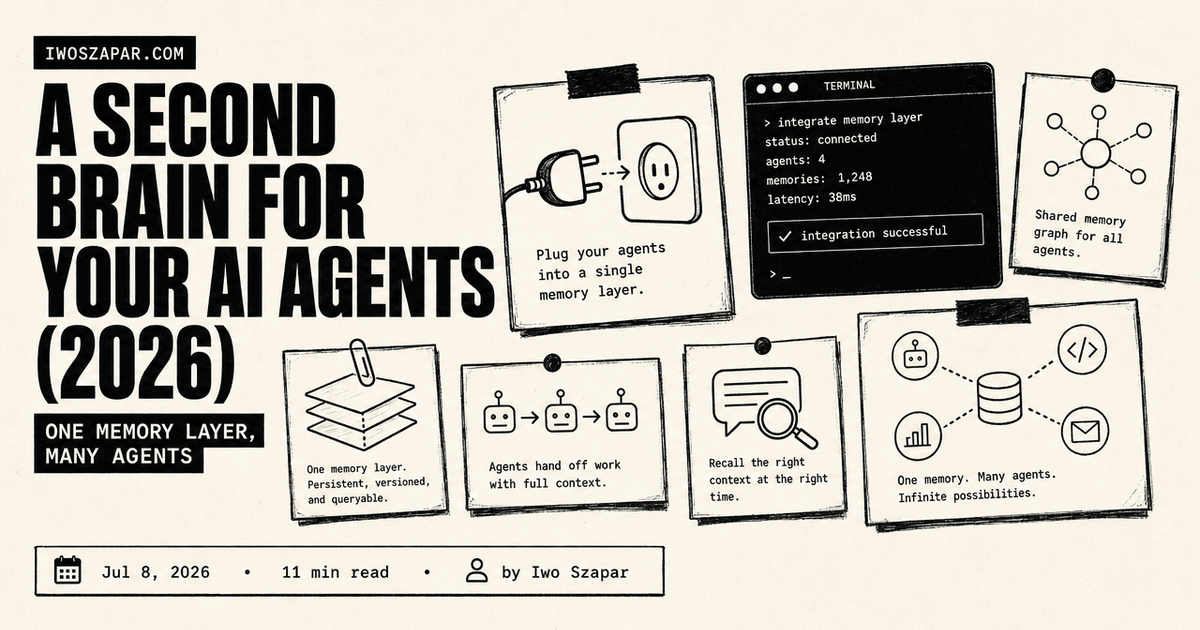
A Second Brain for Your AI Agents (2026)
One memory layer, many agents
I run more than one agent now. There is a coding agent, a research agent, a drafting agent, and a couple of scheduled ones that fire without me in the room. Each is genuinely useful on its own. Together they were, for a while, a mess. Every agent started every task from zero. The research agent found a fact the coding agent needed and had no way to hand it over. I was the memory, ferrying context between them by copy and paste, which is a terrible use of the person who is supposed to be the boss.
The fix was not a smarter agent. It was a second brain for AI agents: one shared memory layer that every agent reads from and writes to, so what one learns, all of them know. This guide is how I set that up, why a fleet needs it more than a single assistant does, and the write discipline that keeps a shared brain from turning into a landfill. It is not about giving a person a second brain. It is about giving your agents one.
What is a second brain for AI agents?
A second brain for AI agents is a single external memory store that multiple agents connect to, read from, and write into, so the whole fleet works from one shared body of knowledge instead of each agent holding its own private, disposable context.
The distinction that matters is scope. A personal second brain remembers things for a human. This remembers things for a team of software agents. The store is the same idea, durable memory that outlives a single session, but the users are your agents, and there are several of them touching it at once.
Think of it like the difference between a note app on your laptop and a shared drive for a team. One is private and yours. The other is a common surface that many people, or in this case many agents, read and update. The value only shows up when more than one participant leans on the same store. If you run exactly one agent, you want a memory layer. If you run several, you want a shared one, and the sharing is the whole point.
Why a fleet of agents needs one shared brain
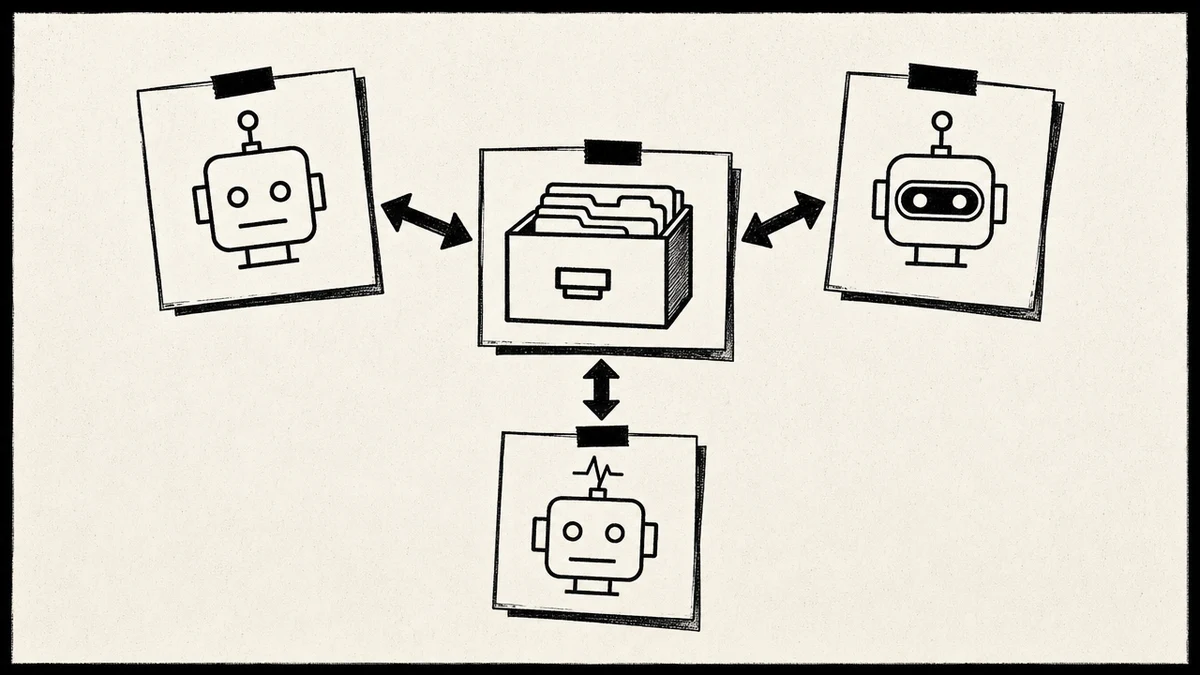
A single agent with memory is a solved problem. You point it at a memory store, it captures and recalls, and it gets better across sessions. I covered that end to end in how to build a second brain with an AI agent. The trouble starts when you have more than one agent and no shared floor between them.
Here is what breaks without a shared brain. Each agent rediscovers the same facts, so you pay for the same research three times. A decision one agent made never reaches the agent that would contradict it, so they act on conflicting assumptions. And you, the human, become the integration layer, pasting the research agent's finding into the coding agent's prompt, which defeats the reason you built a fleet in the first place.
If you would rather not hand-build and maintain that shared floor yourself, that is a fair call. Iwo's Second Brain does the filing and the recall for your agents on Iwo's MemoryOS, so a fact one agent learns is there for the next one without you ferrying it. The zero-risk way to start is the free Health Check, which scores your current setup and asks nothing in return.
A shared brain closes all three gaps at once. When the research agent files a fact, the drafting agent can read it. When one agent records a decision, every other agent recalls it before acting. Nobody starts from zero because the floor is common. The agents stop being isolated tools and start behaving like colleagues who share a filing cabinet.
There is a scale above this one, where a whole company runs a brain that its people and their agents share. If that is your question, the company second brain for AI agent teams is the post for that. What I am describing here is smaller and more mechanical: your own fleet of agents, one memory layer, and the plumbing that makes them share it cleanly.
How the shared memory layer works over MCP
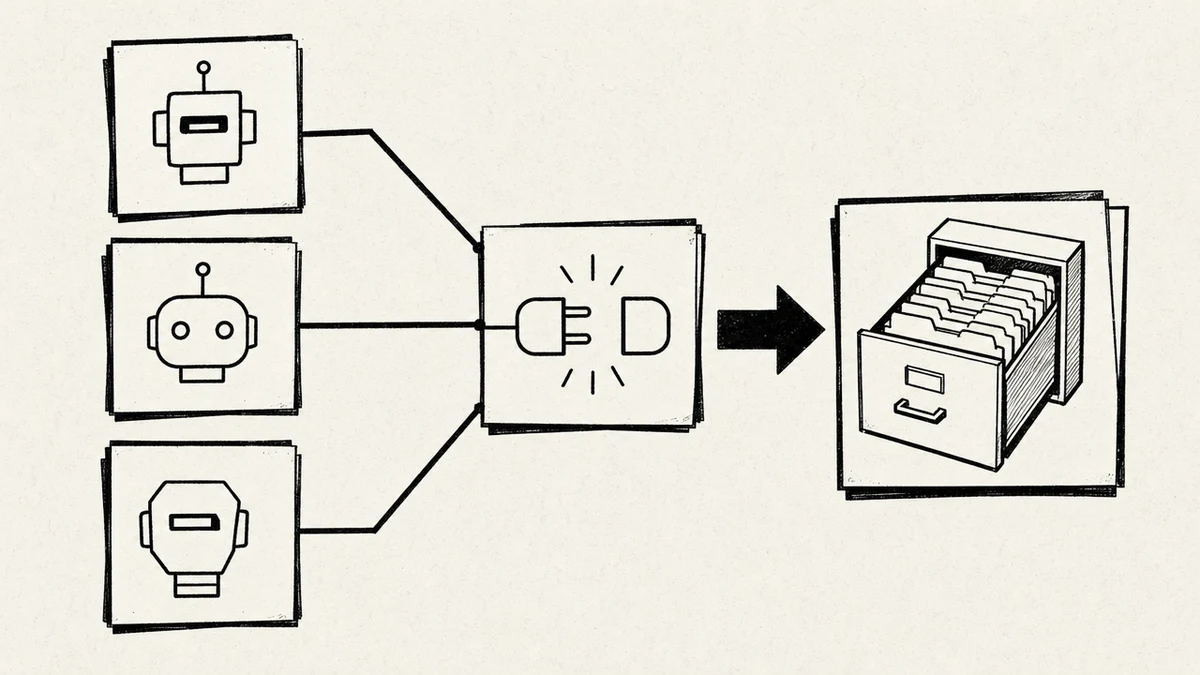
The connection that makes this practical in 2026 is MCP, the Model Context Protocol. MCP is the standard plug that lets an AI client reach an external tool. A memory server is a tool whose only job is holding and returning knowledge, so an agent connected to it gets a set of memory functions it can call like any other tool.
The important property for a fleet is that MCP is a client-to-server connection, and many clients can point at the same server. Your coding agent in one client, your research agent in another, and a scheduled agent running headless can all connect to one memory server. That single server is the shared brain. Each agent calls the same functions, write this fact, find records about this project, list open decisions, against the same store.
So the architecture is boringly simple, which is a compliment. One memory server sits in the middle. Every agent, no matter which client or model it runs on, connects to it over MCP. Reads and writes from all of them land in the same place. I unpack the protocol itself in more depth in the second brain MCP guide, and the wider practice of feeding agents the right context at the right moment in context engineering with MCP. For this post, the one thing to hold onto is that MCP is what lets many agents share a single memory without you wiring bespoke integrations between each pair.
Set up the shared store your agents connect to
The store has to be built for an agent to drive, not a human-first app you bolt agents onto. In practice that means it exposes real functions over MCP, write, query, list, update, so an agent can file and fetch on its own, and it keeps records in a typed structure rather than one undifferentiated blob.
The implementation I run for this is Iwo's MemoryOS, an MCP memory server that keeps knowledge in a set of local database collections rather than a single notes pile. It works with Claude Code, Claude Cowork, Claude Desktop, Cursor, and Windsurf, which is exactly the property a fleet needs: my agents live in different clients, and all of them can point at the same MemoryOS store. The data sits in a local database on my machine, not someone else's server, which matters more, not less, once several agents are writing client facts and private decisions into it.
Setup is the same shape as wiring memory for a single agent, you connect the MCP server to each client, except you do it for every agent in the fleet and point them all at one store. The persistent memory setup guide walks the connection step by step on MemoryOS. Do it once per client, and every agent in that client inherits the shared brain.
Give every agent the same reading and writing protocol
A shared store is necessary but not sufficient. If each agent invents its own filing habits, the brain becomes noise fast. What makes a fleet coherent is a shared protocol: the same short set of rules every agent follows about when to read memory and how to write to it.
I keep that protocol in a memory file each agent loads at the start of a session. It says three things in plain language. Recall before you act, so query the store for relevant context before starting a task. File as you learn, so save decisions, facts, and open loops as they come up. And write to the right type, so a decision goes in as a decision, not buried in a freeform note.
The trick for a fleet is that this file is the same across agents. The coding agent, the research agent, and the scheduled agent all load the same recall-and-capture rules, so they file in a way the others can read back. When the protocol is shared, the store stays legible: any agent can trust that a decision recorded by another agent is where a decision should be. I go deeper on writing that kind of always-loaded instruction file in how to build a second brain with an AI agent, and the same file, copied to each agent, is what turns a pile of agents into a fleet that shares one brain.
The write discipline that keeps a shared brain trustworthy
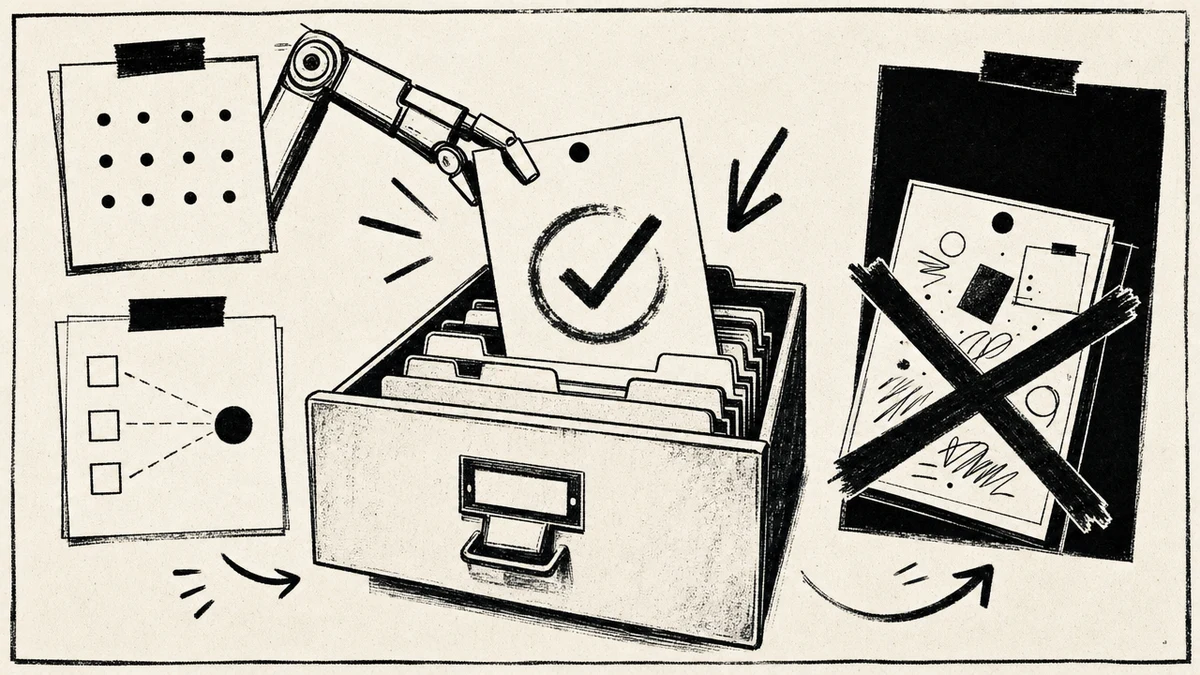
The failure mode of a shared brain is not too little writing. It is careless writing. When several agents write into one store, the risks are duplicates (two agents record the same fact twice), staleness (an old decision never gets superseded), and conflict (two agents write contradictory facts). A single-agent brain rarely hits these. A fleet hits all three by lunchtime if you are not deliberate.
Three habits keep the store trustworthy at fleet scale.
- Write typed, not freeform. Every record goes in as a decision, a fact, or an open loop, so a query can ask for one kind of thing and get a clean answer instead of every message that mentioned a keyword.
- Update, do not just append. When a decision changes, the new state replaces the old one, so recall returns the current version. A store that only ever appends becomes a pile where the truth is buried under history.
- Let something audit it. Facts decay and references break, and no human is going to catch that across a busy fleet. The store itself should flag knowledge that has gone stale or references that no longer resolve.
That last habit is why I lean on a store with monitoring built in. On Iwo's MemoryOS, the standard tier runs ambient monitoring that watches for decayed knowledge and broken references and flags or repairs them, so the shared brain stays trustworthy without me auditing it by hand across every agent. It runs $199 a year, with a free Health Check if you want to score the state of a memory store before committing, and a Pro tier at $349 a year. Pricing is current as of mid-2026 and can change, so confirm on the product page before you commit.
AI Agent Memory Architecture: How Teams Keep Context Current
AI agent memory architecture is the shared layer and workflow that lets agents retrieve useful context from a durable store, write back reusable updates, and keep a trace of what changed. A shared store is part of that architecture. The job of this guide is the memory layer that lets a fleet work from the same base across sessions.
That is the difference between a fleet that remembers useful work and a fleet that repeats old assumptions with more confidence. The memory layer should help an agent find the right context for a job. It should not quietly become a second source of truth beside the CRM, project system, contract, or decision record.
For a team, the working path looks like this:
Request
  -> shared reading and writing instruction
  -> relevant durable memory
  -> current source check when the fact may have changed
  -> typed memory update
  -> reviewable output
  -> next check
The point is traceability. Someone reading the output should be able to tell what the agent used, what it did not know, and where a disputed fact can be checked.
The six parts that make shared agent memory dependable
| Layer | Job | What must stay visible |
|---|---|---|
| Shared memory store | Gives every agent one durable place to retrieve and record useful work. | Which store every agent connects to. |
| Reading protocol | Defines when an agent must recall before it acts. | The question or task that triggers retrieval. |
| Writing protocol | Defines what each agent should capture after it learns or decides something. | The record type and the reason it belongs in memory. |
| Typed lifecycle | Keeps decisions, facts, constraints, and open loops distinguishable and updatable. | What supersedes, confirms, or retires an item. |
| Freshness check | Tests a memory item against the current source when a changing fact matters. | The condition that requires a recheck. |
| Feedback loop | Captures an unsupported, stale, incomplete, or unsafe result so the next run improves. | The correction and resulting update. |
The first four layers keep a fleet coherent. The fifth prevents memory from becoming a historical archive that an agent treats as current. When agents begin working across client, finance, people, or project systems, the team also needs source ownership and access rules. That is the point where shared agent memory becomes a Company Brain problem.
What belongs in agent memory
Store material that has to survive the session and will help another approved workflow: accepted decisions, durable constraints, current commitments, verified facts with a source, and reusable lessons. Keep raw chat traces, half-formed opinions, and private source material in their bounded systems unless a reviewed workflow explicitly turns them into a durable record.
Every memory item needs a home and a lifecycle. A decision should show what changed it. A fact should retain the evidence that supports it. A commitment should name an owner and a next check. When the original source changes, the derived memory should be updated, marked stale, or removed from the route an agent can take.
This is where a typed store such as MemoryOS can help. It gives agents a common place to retrieve and record memory across sessions. The surrounding workflow rules decide whether the material is current enough to use.
How teams keep agent memory fresh
Freshness is a workflow responsibility, not a storage feature. Give each operational source a reasonable review trigger. A project record may need checking before a weekly brief. A signed contract needs checking before a client-facing recommendation. A long-lived decision may only need review when a named condition changes.
When an agent prepares a result, it should retrieve from the source of record for facts that could have changed, then use memory for routing, constraints, and prior decisions. If the evidence is stale, contradictory, or unavailable, the output should say so and leave a next action with the relevant owner. An agent that fills the gap with a confident guess has made the memory layer less useful.
The same discipline applies to updates. Replace or supersede a changed decision rather than appending a new version without context. Record why the change happened and where the current state lives. This gives a later agent a path back to the latest answer instead of a stack of equally plausible historical notes.
Why source ownership and access rules matter
Shared context does not mean unrestricted context. A team may want an agent to summarise project movement while keeping client-specific material, financial detail, or private people information within a defined audience. The memory architecture should preserve those boundaries when a source is retrieved, summarised, or turned into a reusable claim.
The Company Brain guide goes deeper on the team-scale version: approved sources, access rules, decision history, and accountable workflows. Company Brain is the practical operating layer for applying that model to a real team. This guide stays focused on the shared-memory layer that lets several agents operate from one coherent base.
A bounded example: a weekly client commitment brief
Take a weekly brief for a client team. The workflow can read only the approved meeting notes, the current project record, and accepted commitments for the reporting window. It should produce decisions made, movement, risks, next commitments, unresolved questions, and a source list. It stops for human review before distribution.
That is the pattern behind the Client Commitment Radar: give an agent a narrow job, an approved source set, a clear output contract, and a named review point. The useful result is not a generic summary. It is a brief where a client-facing commitment can be checked against the source that owns it.
Questions teams ask about AI agent memory
Is a vector store enough for team agent memory?
A vector store can help retrieve unstructured material. It does not define source authority, access, freshness, or the review process for a consequential output. Teams need those controls around retrieval so an agent can distinguish a useful reference from current operational truth.
How do I keep AI agent memory fresh over time?
Define a source owner and freshness trigger for each important kind of information. Retrieve current facts from the relevant system of record, mark derived memory stale when its evidence changes, and make the workflow surface missing or contradictory evidence instead of hiding it.
Where should an agent's past interactions live?
Keep raw interactions in the system that governs them. Promote only the durable decision, verified fact, commitment, or reusable lesson that an approved future workflow needs. Record the evidence, scope, and next check with the promoted item.
Where a shared agent brain fits in the bigger stack
A shared memory layer is one component of running your work with AI, not the whole thing. The fuller picture is an assistant, a set of skills or agents, a file system, and a memory layer, working together. I framed that whole stack in the personal AI operating system. The second brain for your agents is the memory component of that operating system: the part that remembers, so the rest of the stack does not keep re-learning.
That framing also tells you when you have overbuilt. If you run one agent, you do not need shared memory, you need memory. Reach for a shared brain at the moment you have a second agent that would benefit from what the first one learned. That is the threshold. Below it, the sharing is overhead. Above it, the sharing is the whole reason a fleet outperforms a single agent.
FAQ
What is a second brain for AI agents?
A second brain for AI agents is a single shared memory store that multiple agents connect to, read from, and write into over MCP. It differs from a personal second brain because the users are software agents, not a human, and several of them touch the same store at once. The value comes from the sharing: what one agent learns, every other agent can recall.
How is this different from giving one agent memory?
Giving one agent memory solves recall for that agent alone. A second brain for a fleet gives many agents one common store, so a fact the research agent files is readable by the drafting agent, and a decision one agent records is recalled by all of them. The mechanics of a single-agent memory are covered in how to build a second brain with an AI agent. The shared version adds a write protocol so multiple writers do not corrupt the store.
How do multiple agents share one memory layer?
They connect to the same MCP memory server. MCP is a client-to-server protocol, and many clients can point at one server, so agents running in different clients or on different models all read and write the same store. Each agent calls the same memory functions against that single server, which is what makes the brain shared rather than duplicated.
Do I need to code to set this up?
No. The work is configuration, connecting an MCP memory server to each agent's client, plus writing a plain-language protocol file that tells every agent when to recall and how to file. A packaged option like Iwo's Second Brain on MemoryOS ships the store and the typed structure, so you spend your time on the protocol, not on building a database.
Which AI clients can share one agent memory store?
Any client that speaks MCP can point at the same memory server. Iwo's MemoryOS works with Claude Code, Claude Cowork, Claude Desktop, Cursor, and Windsurf, so agents living in different clients can share one store. The persistent memory setup guide covers the connection per client.
How is this different from a company second brain?
Scale and audience. A second brain for your agents is your own fleet sharing one memory layer, a mechanical, personal setup. A company second brain is an organization where people and their agents share a brain across a whole team. If your question is team or company scale, the company second brain for AI agent teams is the post that covers it.
What keeps a shared store from filling with duplicates and stale facts?
Write discipline and monitoring. Every record goes in typed, so queries stay precise, and changed decisions update in place instead of appending forever. On a store with a monitoring layer, like MemoryOS, the system flags decayed knowledge and broken references on its own, so trust does not depend on any single agent, or you, auditing the brain by hand.
Give your agents one brain to share
A fleet of agents only compounds if they share what they learn, and that sharing has to live somewhere trustworthy. Iwo's Second Brain ships the shared store, the typed surfaces, and the agent protocol on Iwo's MemoryOS, so every agent you run reads and writes one brain instead of starting from zero.
The single next step, and the one that costs you nothing, is the free Health Check. It scores the state of your current memory setup and shows you where a shared brain would close gaps, with no commitment either way. If it turns out you only run one agent today, you will know that too. For the wider stack this all sits inside, read the personal AI operating system.
If your team works in the public interest, the same discipline applies. Digital transformation for nonprofits shows how to start with safe sources, human review, and one workflow that people can check.
Related guides
Read next
Your Second Brain is blind without MCP
How Model Context Protocol turns stored memory into action.
Apply it
Second Brain Setup Health Check
Score an existing setup and see what is missing.
Product path
MemoryOS
Persistent memory and skill infrastructure for serious AI work.
Product path
Second Brain 2.0 for developers
The full operating system for Codex, Claude Code, and local agent workflows.