What Is a Company Brain? A Governed Context Layer for Teams and AI Agents
A practical guide to giving people and AI agents the right company context for one recurring job, with visible sources, permissions, review, and handover.
A Company Brain gives people and AI agents a governed route from source-owned company knowledge to one recurring business job. It defines which context may be used, who may use it, who verifies the result, and how corrections and handover become part of the next cycle.
In August 2026, I tested a complete 50-page mirror of my Company Brain. It passed 22 of 23 retrieval checks and all 6 graph checks. The missing result concerned the source contract, even though the correct architecture page was already in the index.
The data was there. The operating rule was too implicit.
I added one sentence near the top of the canonical architecture page. It named the owner, freshness or refresh method, access classification, intended use, permitted method, dependencies, and excluded uses for every source entry. In an isolated clone of the same mirror, the result moved to 23 of 23 retrieval checks while the graph checks stayed at 6 of 6.
That test changed how I think about company knowledge for AI. An agent can find the right page and still do the wrong work. The missing layer is a governed route from company evidence to an accepted action that another person can inspect, correct, and continue.
That is the job of a Company Brain.
This was an internal retrieval test. It did not measure customer value, adoption, revenue, or a finished product. It proved a narrower point: stored knowledge becomes dependable operating context only when authority, use, and limits are explicit.
What is a Company Brain for AI agents and teams?
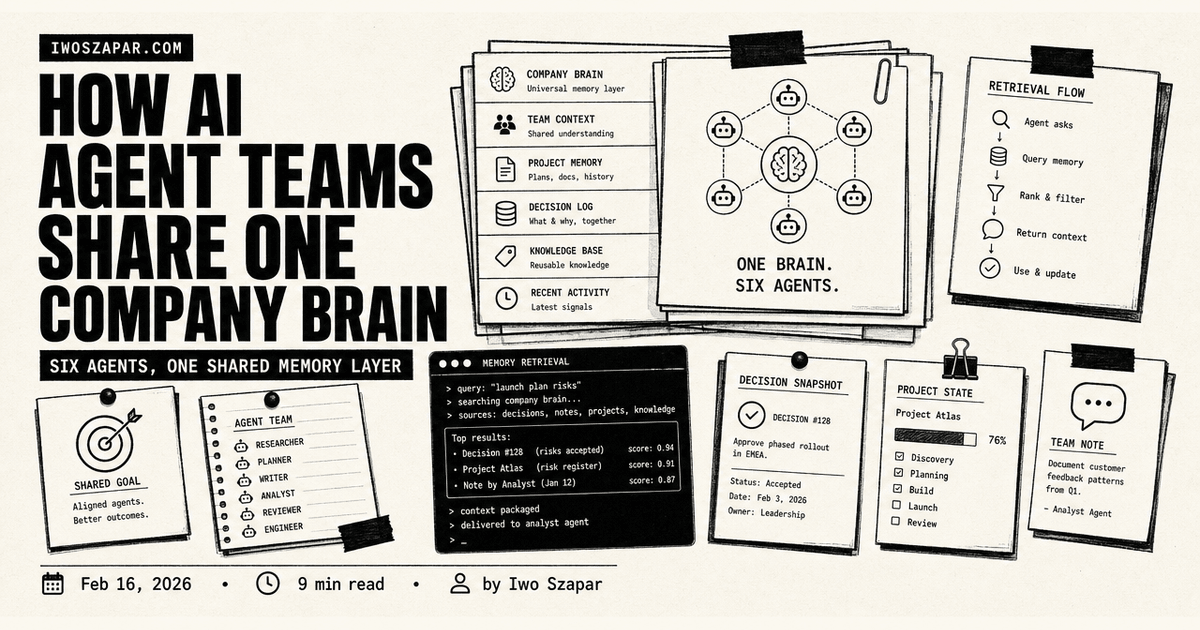
A Company Brain is a governed operating layer that connects source-owned company context to people and AI agents for a defined job. It selects approved information from the systems that own it, applies the relevant permissions and rules, and produces work a named person can inspect, correct, and continue.
The first useful version covers one recurring decision, review, or handover. It does not need every document in the company. It needs the smallest set of current, permitted evidence that can support a reviewable result.
For AI agents
A Company Brain tells an agent which sources belong in the job, why they belong, what the agent may do with them, and where its authority ends. The agent receives a bounded context packet instead of unrestricted access to the company archive.
For teams
A Company Brain helps a team stop rebuilding the same context around recurring work. It makes source authority, conflicts, review ownership, corrections, and the next handover visible so another person or agent can continue without reconstructing the full history.
The truth remains in the existing systems of record. A signed agreement may own scope. A project plan may own current delivery dates. A security register may own a control status. A private note may add context for its author while remaining excluded from shared work. The Company Brain carries those boundaries into the workflow.
That makes it different from several adjacent tools:
It can supply a source, but it usually does not carry a result through permission, review, correction, and handover.
Retrieval cannot decide which source wins, who may use a claim, or who accepts the resulting work.
Retained state still needs an owner, audience, expiry rule, and correction path.
A Company Brain adds organisational ownership and continuity around that technical work.
It is a bounded use of the wider Company Brain approach.
It connects sources to a human decision, accepted state, correction, and handover.
Anthropic describes context engineering as curating the instructions, tools, external data, and message history available to an agent. That discipline belongs inside a Company Brain. The organisational question continues before and after the model receives its context: who owns the source, who may use it, who checks the work, and what becomes the starting state for the next cycle?
The context engineering guide covers that narrower technical practice. This article stays with the organisational operating layer around it.
As of September 2026, OpenAI Frontier and Microsoft Agent 365 both make business context, agent identity, permissions, evaluation, and auditable action explicit. Their direction does not prove that Company Brain has become a settled category. It does show that reliable agent work now depends on more than retrieval quality.
One operating model, from source to handover
I use one operating sequence to judge whether a Company Brain workflow is real:
Consider a weekly client review. The workflow retrieves the signed scope, current delivery plan, approved decisions, and recorded commitments. It produces a commitment-delta table showing the source, date, changed condition, impact, owner, status, and next check.
The delivery lead can accept an item, correct it, reject it, or leave it unresolved. If two sources disagree, the workflow keeps both claims visible and assigns the conflict. If the correction reveals a weak rule, the team updates the source register, instruction, permission, or evaluation case. Accepted commitments become the starting point for the next review.
The sequence matters because most failures appear at the joins:
Freshness and authority are unclear.
Name the canonical source, owner, review date, and expiry rule.
The workflow has no conflict rule.
Keep both claims visible and assign the decision.
Audience and permitted use were never defined.
Exclude personal context by default and approve shared contributions.
Identity, operation, field scope, and recovery are vague.
Use read-only mode first, then define approval, expiry, trace, revocation, and recovery.
The fix stayed in chat.
Change the source, rule, permission, or test, then verify from a fresh session.
The operating knowledge was never transferred.
Have a receiving operator run and repair a representative case alone.
Choose no build when the job does not repeat, the source owner is unknown, or nobody can verify the result.
This model keeps the vocabulary under control. A source register names what the workflow may trust. An authority map names what people and agents may do. The artifact is the work under review. The accepted state is the part another cycle may rely on. Everything else should justify its place by repairing a real failure.
Three workflows that make the idea concrete
The fastest way to understand a Company Brain is to follow a recurring job from trigger to handover. These three workflows come from the client-delivery part of my own company. They are implementation directions I am testing, not published customer case studies.
1. Client Commitment Radar
Commitments often scatter across a signed scope, project plan, approved decisions, and later client requests. The Client Commitment Radar answers a practical question: what did we promise, what changed, and who owns the next check?
The workflow starts with a scheduled review or a material scope change. It may read the signed agreement, approved change orders, current plan, and commitments owned by the account team. It excludes private notes and unrelated accounts. Requests remain outside until they become approved scope.
Its artifact is a commitment-delta table. The account or delivery lead reviews every changed item, while conflicting evidence moves into an exception queue with an owner. The agent may compare commitments and prepare the review. It may not send a client message or change a source record.
The next cycle begins from the commitments the lead accepted. Stop when the team cannot name an authoritative source or a person able to verify the result.
2. Proposal and RFP Evidence Desk
Proposal work becomes risky when a strong claim is easier to write than to prove. The Proposal and RFP Evidence Desk shows which claims have current, publishable evidence and which proof is still missing.
A new pursuit, tender, or evidence refresh triggers the workflow. Approved capability descriptions, permissioned case evidence, current security material, and commercially owned terms may enter. Draft anecdotes, expired documents, and customer evidence without publication permission stay outside.
The resulting claim-to-evidence matrix records source, owner, freshness, audience permission, limitation, and the exact missing-proof question. The pursuit owner verifies commercial claims, with legal or security review where required. Unsupported claims are removed or escalated; the agent cannot fill the gap with plausible language.
The matrix becomes reusable only after corrections reach the owning evidence source. Stop when a required claim cannot be supported or safely published.
3. Client Onboarding and Handover Desk
An account becomes fragile when delivery quality depends on one person's memory. The Client Onboarding and Handover Desk turns a signed deal, account transfer, or project phase change into a handover that the next owner can run.
The approved context includes the accepted agreement, current delivery plan, approved decisions, commitments, access responsibilities, risks, and open exceptions. Credentials never enter the artifact, and an informal message cannot override the agreement.
The workflow produces a handover pack and acceptance checklist. The incoming owner then runs one representative case from a fresh session, inspects why each source was used, applies a correction, and recovers from a known exception.
Ownership changes only when that person can continue without the original builder. A demo is not handover.
These examples share the same loop, but the business artifact changes. One protects commitments, one protects claims, and one protects continuity. That is enough variety to test the operating model without turning the article into a catalogue of hypothetical agents.
How to plan the first implementation
Implementation begins before anyone chooses a model or connector. The planning job is to decide whether one recurring process deserves a governed AI workflow, and what would make it safe enough to test.
Decide whether the problem deserves a Company Brain.
Map one recent case, its sources, owners, delays, and exceptions.
Choose one bounded use case and reject unsafe candidates.
Define the artifact, authority, evaluation, and stop rule.
Run real cases in read-only or shadow mode.
Continue, redesign, or stop from evidence.
1. Make a readiness decision
A good candidate has a recurring trigger, a visible context failure, a known source owner, a human who can judge the output, and a state that should improve after acceptance.
Choose go when the source set can be bounded and the artifact can be tested. Choose defer when the problem is real but access, ownership, or review capacity is missing. Choose no build when a clearer template, checklist, or ownership rule would remove most of the failure.
An AI layer cannot repair a source that nobody owns. It can only make the ambiguity travel faster.
2. Discover how the work really happens
Map one recent case from trigger to accepted outcome. Interview the person doing the work and the person accepting it. Inspect the sources they actually used, including any unofficial spreadsheet or private note that compensates for a broken process.
Record elapsed time separately from human touch time. A draft may take ten minutes while waiting, searching, reconciliation, and review take three days. Faster drafting would barely change that workflow.
Discovery should leave behind a current workflow map, source inventory, exception list, baseline, and examples of accepted, corrected, rejected, and unresolved outputs.
3. Choose one use case and reject the others
Rank candidates by frequency, cost of delay or rework, source authority, availability of a verifier, reversibility, sensitivity, measurability, and handover potential. Record the rejected candidates and the reason for each rejection.
High impact alone cannot rescue a workflow with disputed truth, irreversible actions, or no reviewer. The best first use case is often boring enough to repeat and important enough that errors already cost time or trust.
4. Write the operating contract
Name the accepted artifact before naming the technology. A summary is too vague. Define what the artifact contains, what counts as good enough to use, who reviews it, where uncertainty remains visible, and what starts the next cycle.
The minimum contract covers:
- the source register, including authority, owner, freshness, access, purpose, and exclusions;
- the authority map for human and agent identity, permitted operations, field scope, audience, expiry, and approval;
- normal and failure evaluation cases;
- the correction owner and exception path;
- the accepted state and next trigger; and
- the handover test and stop condition.
For consequential writes, approval is only one control. The contract also needs a before-and-after trace, a recovery owner, a revocation path, and an idempotency or compensation mechanism so a retry cannot create a second unintended action.
5. Run a supervised pilot
My current test shape is deliberately narrow: one account or workstream, no more than three approved read-only source categories, one named verifier, four reviewed output cycles, and a day-30 continue-or-stop decision. The first output is due within seven days of complete onboarding. This is a delivery contract to test, not a promise of customer results.
Each cycle records its input window, sources, exclusions, artifact, human decision, corrections, exception state, and next trigger. Review minutes, first-pass acceptance, correction severity, exception volume, and fully loaded cost per accepted outcome tell me more than the number of documents retrieved.
6. Prove handover or stop
At day 30, continue when the artifact has entered the normal workflow, the verifier uses it, corrections remain manageable, and the next cycle starts from a better state. Redesign when the job matters but the artifact or boundary is wrong. Stop when the source owner remains absent, the output is not accepted, or the control burden exceeds the value.
Delivery structure changes accountability. Platform access leaves discovery, governance, adoption, and support with the client. Expert capacity adds specialist time while the client coordinates the result. A productised deployment gives one lead responsibility for a bounded workflow through pilot and handover. Capability transfer teaches the receiving team after the workflow has survived real cycles.
For a first high-consequence workflow, my current recommendation is productised deployment followed by capability transfer. That is a working delivery hypothesis from a September 2026 market map of 30 companies and programmes across seven delivery archetypes. I reviewed first-party public descriptions of what each model sells; I did not audit their revenue, retention, customer outcomes, or delivery quality.
What my own company evidence proves
I have used the same control pattern in several parts of my company: define the trigger, limit the sources, expose conflicts, produce inspectable work, and stop when evidence or authority runs out.
The examples below do not carry the same proof strength. A live internal workflow says more than a staged retrieval slice. Neither establishes a customer result.
Strongest operating evidence here; no customer or commercial outcome claim.
Decision preparation passed; adoption remains unproven.
Stopped an unsupported conclusion; decision effect remains unproven.
A live relationship-status projection
Historical CRM company labels can be true about a past relationship and false about a person today. Calendar and email history also do not prove current employment or permission to contact.
The workflow selects relationship-backed people with a valid public profile and a time-stamped employment observation from the approved external source. It keeps the historical CRM fields unchanged and writes current company, role, confidence, source, retrieval time, and next review into a separate projection.
One controlled run checked 387 people. It classified 176 as confirmed current, 3 as likely current, 149 as moved, and 59 as unknown under the workflow rules. That means 211 records could not silently become confirmed-current personalisation.
What this proves: the workflow can preserve historical relationship evidence while maintaining a separate, time-bounded view of current employment.
What this does not prove: consent, response, revenue, or a better commercial decision.
A bounded partner decision brief
For a planned NGO programme discussion, the brief had to prepare four decisions: whether to pursue the programme, who would own coordination, which evidence was required before commitment, and which real NGO jobs belonged in the first cohort.
It used two scoped repository sources and excluded beneficiary data, direct contact details, inbox and calendar content, unrelated CRM records, legal records, and raw external programme repositories. All four planned retrieval questions passed, including whether a planning amount had been approved. The correct answer was no.
What this proves: a bounded source set can support decision preparation while preserving a safe refusal around unapproved funding.
What this does not prove: that the meeting happened, the programme was accepted, or the proposed roles, funding, and scope became real.
A CEO brief that withheld a revenue conclusion
One September rehearsal found one economic transaction represented by two raw Stripe charge records. Across the rolling 30-day view, 14 raw charge representations reduced to 7 economic transactions. The workflow found no exact Factory ownership record for the current transaction and conflicting fee information.
The read-only brief withheld the revenue conclusion and left repair in its owning issue. A later window had complete ownership linkage and could report two owned-product payments. I do not combine those windows into a stronger story.
What this proves: the control stopped an unsupported financial conclusion when ownership evidence was incomplete.
What this does not prove: that the brief changed a decision or improved performance.
These examples explain why I keep proof boundaries beside the claim. A test result can prove a retrieval behavior. An accepted internal artifact can prove use inside a workflow. Payment, repeat use, customer value, handover, and permission to publish remain separate evidence states.
Where this goes next
The market vocabulary will keep changing. I expect people to search for business context for AI agents, organisational memory, non-human identity, context drift, agent evaluation, tool governance, private agent context, and human-agent handover.
Those terms point to the same operating anxiety: companies want agents that can act with useful context without losing control of source authority, permission, correction, and accountability.
A connector can expose a capability. The workflow still has to decide whether an agent may use it for this job. The Model Context Protocol roadmap treats authorisation and enterprise readiness as active protocol work. A Company Brain should work with identity, access management, legal, and security systems, not pretend to replace them.
Scaling should mean that the next workflow inherits proven source rules, evaluation cases, correction patterns, and handover practices. More connected documents and more agents are not enough. Add a second workflow only after the first has an accepted artifact, a stable verifier, a maintenance owner, a handover result, and evidence that the value exceeds the control burden.
Choose one useful next step
Bring one recurring job, the systems that own its context, one recent failed or expensive example, and the person who can verify the result.
Then ask:
- What exact artifact would make this job easier to review or continue?
- Which sources may the workflow trust, and who owns them?
- What must stay excluded?
- Who can accept, correct, reject, or hold the result?
- What would make us stop?
If those answers are available, choose one bounded workflow from the Company Brain page. If one team keeps rebuilding the same decision or handover context, Team Brain may be the better boundary. For personal work, start with the personal Second Brain.
When nobody can name the source owner or verifier, repair the operating process first. A useful first answer may still be no build.
Frequently asked questions
Can several AI agents share a Company Brain?
Yes, when every agent has a defined identity, purpose, source scope, tool permissions, and approval boundary. Shared context does not require identical access.
How is a Company Brain different from RAG?
Retrieval-augmented generation helps find relevant material. A Company Brain also defines source authority, permissions, workflow rules, evaluation, correction, accepted state, ownership, and handover.
Do we need to move all company knowledge into one system?
No. Start with the smallest approved source set needed for one recurring job. Keep the original systems as owners and add another source only when a real workflow failure exposes a gap.
Can it work with Copilot, ChatGPT, Notion, or our existing knowledge stack?
Yes, when those tools can operate inside the workflow's source, identity, permission, and review boundaries. The Company Brain defines which system owns each fact, what context may move, and who verifies the work.
Who owns sources and corrections?
The operating team keeps ownership of its source systems, access decisions, and accepted business state. Every source and correction rule needs a named owner. Corrections belong in the owning source, instruction, permission, or evaluation case, not only in chat history.
Does a Company Brain make an AI workflow compliant?
No. It can make source authority, permissions, evaluation, corrections, and evidence easier to inspect. Compliance still depends on applicable law, system classification, organisational controls, contracts, and qualified legal or security review.
How long does implementation take?
The timeline depends on source access, permissions, evaluation cases, and handover requirements. The bounded pilot described here targets a first output within seven days of complete onboarding and a day-30 decision. That is a test contract, not an organisation-wide promise.
Is there a self-hosted or open-source Company Brain?
I do not claim a released self-hosted or open-source Company Brain offer. Private deployment and data-locality requirements are useful qualification questions. They need a defined technical, security, update, support, and commercial model before becoming a product.
Choose your next step
Choose the layer that makes shared context usable
tutorial
Graph Engineering
Graph Engineering explains how to make relationships between people, decisions, and sources usable for teams and agents.
Map the knowledge before you automate the work
template
Loop Engineering
Go past the prompt. Learn how to design self-running AI loops with verifier ladders, open vs closed loop rules, cost caps, and real proof gates.
Get Loop Engineering
Related guides
Read next
Build an AI agent workflow
Turn governed context into a process with explicit steps, handoffs, and a quality gate.
Read next
Build a Second Brain with an AI agent
Set up the durable instruction, memory, and correction loop behind an agent.
Product path
AI Second Brain
Explore the path for having the context system built around your work.