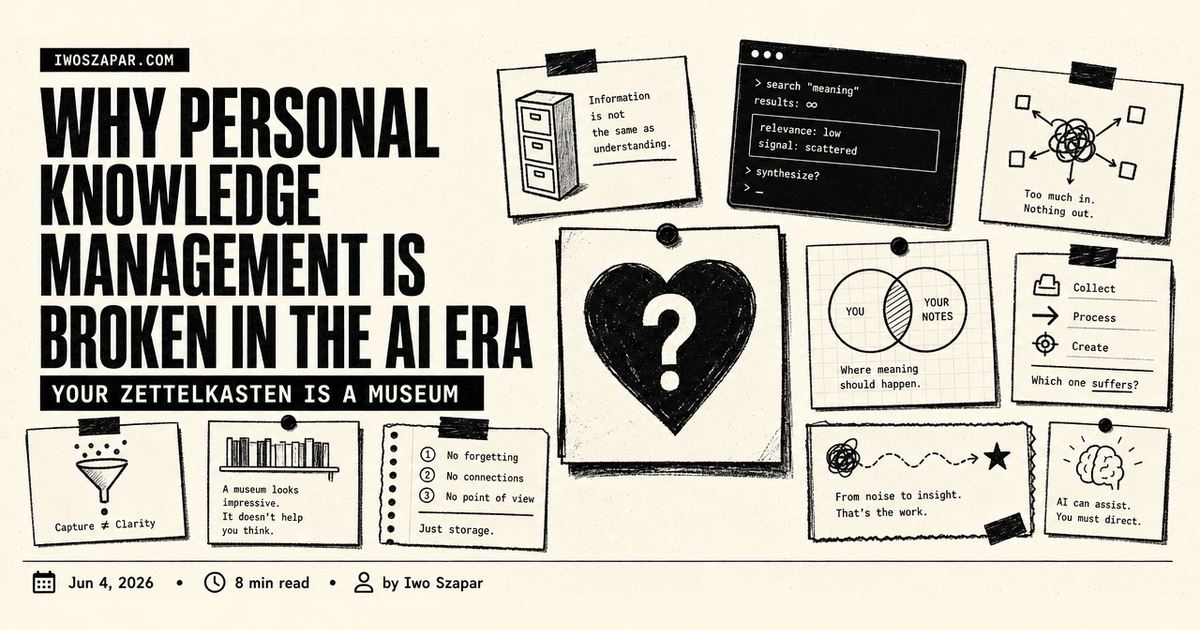
Why personal knowledge management is broken in the AI era
Your Zettelkasten is a museum
The AI does not care about your backlinks. It does not walk your graph or admire your daily notes. It reads text, scores relevance, and answers. Most personal knowledge management advice was written before that was true, and we kept filing notes as if nothing had changed.
I have built knowledge systems for a decade, and I sell one. So when I say most of what we taught about PKM is now wrong, I am arguing against my own past work too.
You can see the failure in a single scene. Someone with a 4,000-note vault, every note tagged and linked, sits down to ask their AI a question about their own project. The answer comes back generic, because nothing in that beautiful vault is in a shape the model can use. The notes exist. The memory does not.
What personal knowledge management was built to solve
For twenty years, personal knowledge management optimized for a single constraint: helping a human brain retrieve what it had already seen.
Every popular system attacked that problem from a different angle. Zettelkasten linked atomic notes so you could follow a thought across years. Getting Things Done captured open loops so your mind could let them go. Building a Second Brain told you to save now and resurface later. PARA gave you four folders so nothing got lost.
All of it was retrieval engineering for wetware. The enemy was forgetting. The tools were backlinks, tags, daily notes, and graph views, and they worked because the bottleneck was real. You could not find what you wrote six months ago, so you built scaffolding to find it.
And we loved the scaffolding. Building the system felt like thinking. Arranging notes, drawing links, and tending the graph gave the satisfying sense of progress without the harder work of using what we knew. The tools rewarded maintenance, and maintenance felt like mastery.
What changed
Large language models made retrieval cheap and synthesis instant.
Ask a model to find the thread about pricing across a year of notes and it does it in a second, with no manual links required. Ask it to summarize a long document and it returns three sentences before you finish your coffee. The expensive operation became free.
This is not a passing trend. The cost curve moved and it is not moving back. Context windows keep growing, embeddings keep getting cheaper, and models keep getting better at reading raw text. Every month, the case for hand-built retrieval scaffolding gets weaker.
When retrieval got cheap, the bottleneck moved. For twenty years the hard part was finding what you wrote. Now the hard part is getting the model to use what you wrote, at the right moment and in the right form. That is a different problem, and it breaks most of the old advice.
Why old PKM advice fails now
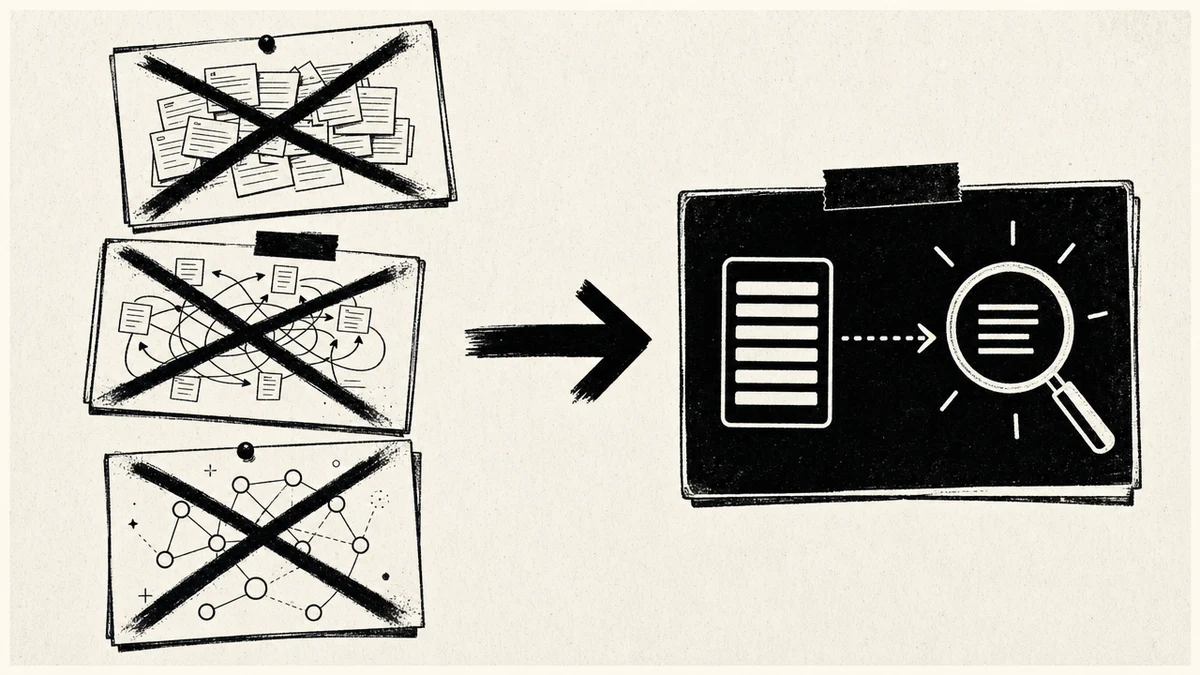
Three specific examples, because the shift is concrete.
Atomic notes. The advice to break ideas into small, single-concept notes solved a human problem. We chunk badly and lose the thread in long documents. The model chunks for you. It reads a 3,000-word page and pulls the one relevant paragraph without help. The atomic note gives way to the typed record the model can read with intent: a decision, a fact, an open loop, a project state.
Manual backlinks. Linking notes by hand was how you found your way around your own notes. Embeddings made that obsolete. Semantic search finds related material exhaustively and for free, including connections you never thought to draw. Maintaining backlinks by hand in 2026 is busywork the AI already did. The irony is that the model finds better links than you do, because it has read every note and you have not opened most of them in months.
Graph views. The graph was always for human eyes. It gave you a sense of shape. The model does not look at the graph. It looks at the text. A beautiful knowledge graph is decoration that does not change a single answer the AI gives you.
| Old PKM move | Why it mattered | What replaces it |
|---|---|---|
| Atomic notes | human chunking | typed memory surfaces |
| Manual backlinks | human navigation | embeddings and semantic search |
| Graph views | human overview | direct text queries |
What works in the AI era
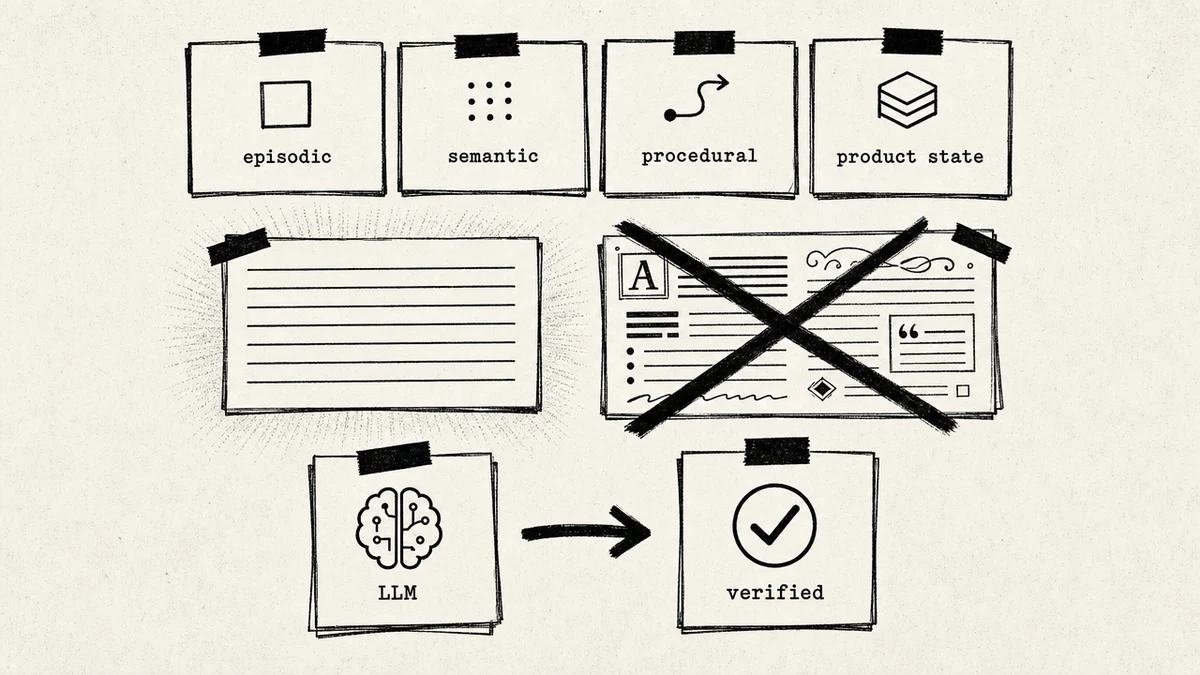
Three principles, and they are the opposite of busywork.
Type your memory. Stop writing one undifferentiated pile of notes. Separate episodic, semantic, procedural, and product-state memory. The model reads each surface with a different question, so typed memory returns better answers than a flat archive.
In practice this looks simple. Your decisions live in one place, your durable facts in another, your project status in a third. Ask the model what you decided about pricing and it searches decisions and ignores the rest. The structure does the filtering before the model even reads.
Optimize for retrieval, not aesthetics. Plain text with light metadata beats rich blocks with embedded tables and nested toggles. The model reads the text. Everything you added for visual comfort is weight it ignores.
Trust the AI for synthesis, distrust it for storage. Write everything down, because the model will confidently invent what you never recorded. Then let it summarize, connect, and retrieve on demand. You capture truth. It shapes it.
The tools that adapted
Some tools took the new constraint seriously. Mem rebuilt around self-organizing capture. Reflect put AI on top of daily notes and backlinks. Tana made smart tags that drive both structure and prompts. mem0 turned memory into an API for agents. MemoryOS, the one I build, went all in on typed surfaces and recall scoring.
These tools share one pattern. Each started from the question "what does memory look like when an AI is the primary reader" instead of "how do we help a person file notes."
The tools that did not
Notion, Roam, and Evernote were built for the old constraint, and it shows.
No knock on those teams. Notion is an excellent workspace. Roam pioneered networked thought. Evernote defined capture for a generation. They optimized brilliantly for human retrieval when that was the whole game. The game changed underneath them, and a workspace designed for human eyes is hard to retrofit into a memory layer designed for machine reading.
What to do this week
Three concrete moves.
Audit your system. Open your PKM and ask, feature by feature, which parts help your AI workflow and which parts you maintain out of habit. Be honest about the graph view.
Stop maintaining backlinks by hand. Let semantic search do the work and reclaim the hour a week you spent linking.
Move from atomic notes to typed memory. Take your most-used notes and sort them into four buckets: what happened, what is true, how you do things, and where projects stand. That single change does more for your AI workflow than any tagging system.
The bet
The new PKM rewards one thing above all: memory a model can read.
I put my money on that thesis. MemoryOS and the Second Brain template are my bet on what comes after the note-taking era, built around typed memory and recall the model can trust. You do not need either to act on any of this. The only requirement is to stop optimizing for a constraint that disappeared.
Your Zettelkasten can stay a museum. Just stop asking it to be your memory.
FAQ
What is PKM and why does it matter in 2026?
Personal knowledge management is how you capture and retrieve what you learn. It matters more now, not less, because AI assistants are only as good as the memory you give them. The methods changed. The need did not.
Did Notion get worse, or did the world get better?
The world changed. Notion is the same strong workspace it always was. The job people now want from it, fast AI memory, is a different job than the one it was designed for.
Is Zettelkasten dead?
As a tool for human thinking, no. As advice for building AI-ready memory, mostly. Manual linking is the part the AI made redundant.
Should I rebuild my entire notes system?
No. Start with one change: sort your active notes into typed surfaces. Rebuilding everything tends to become a way to avoid starting.
What is typed memory and how do I start using it?
Memory split by kind: episodic, semantic, procedural, and product state. Start by putting your decisions in one place and your durable facts in another. The model reads each differently, and that alone improves recall.
Where do I read more about this?
Iwo's MemoryOS page lays out typed memory in practice, with the surfaces and the recall model spelled out.
Related guides
Read next
The AI second brain guide
What an AI second brain is, and how the pieces fit together.
Read next
How to use PARA in an AI second brain
Where the PARA folders still help once AI holds the context.
Apply it
Second Brain demo
See the product workflow before choosing a package.
Product path
AI Second Brain
The product path for people who want the system built.