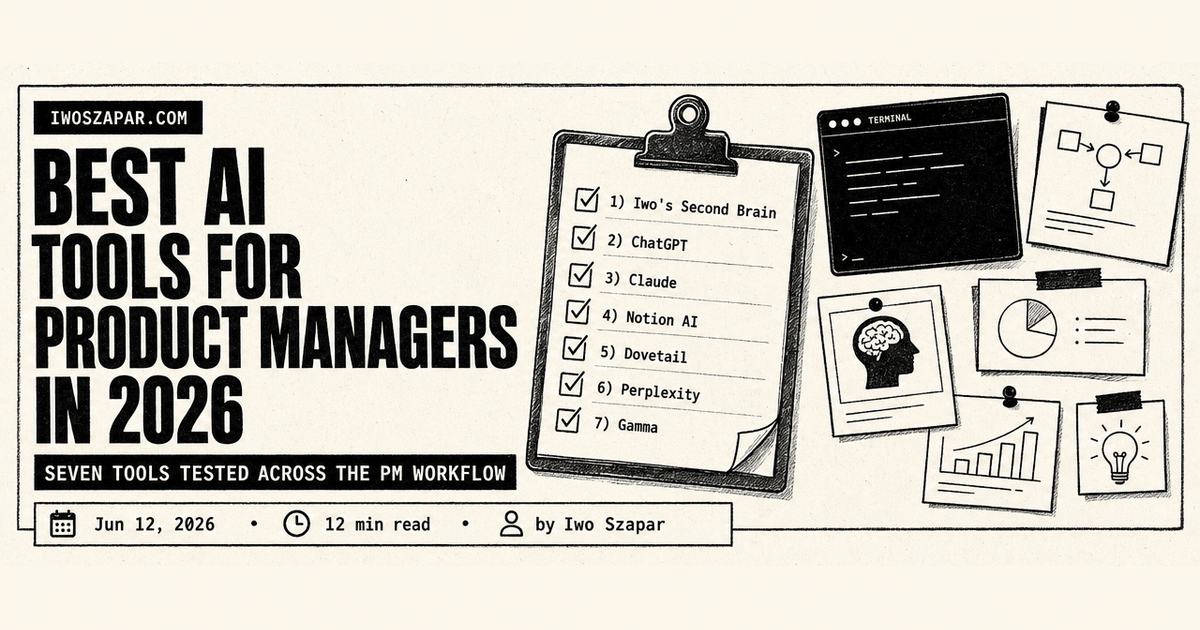
Best AI tools for product managers in 2026
Seven tools tested across the PM workflow
Product management is a job of synthesis. You turn scattered user signals, stakeholder opinions, and data into a decision, a spec, and a plan. AI is unusually good at the synthesis part, which is why the right tools can give a PM back the hours that meetings and document wrangling quietly take.
This guide covers seven AI tools tested across the real PM workflow: user research, PRDs and specs, roadmapping, stakeholder communication, and the new habit of prototyping directly. Each entry has honest pros, real trade-offs, current pricing, and a clear sense of who it fits. Pricing is current as of mid-2026 and moves often, so confirm before you buy.
Disclosure: Iwo is the maker of Second Brain and MemoryOS, and they sit at number one here. They are our own products, so read this as a recommendation with skin in the game, which is why we put them first. They earn the top slot for the one job they do better than a general assistant, persistent product memory that compounds across releases and research, with honest cons kept. The rest of the list is ranked on merit, and the general assistants and the research platform that follow may matter more for your specific bottleneck.
Best AI tools for product managers: a brief overview
If you want product knowledge to compound:
- Iwo's Second Brain for the best overall foundation, a structured memory layer across releases and research
If you are writing specs and docs:
- ChatGPT for the broadest everyday assistant
- Claude for PRDs, careful reasoning, and long-document synthesis
- Notion AI for specs and roadmaps inside your team's workspace
If you are learning from users:
- Dovetail for turning interviews and feedback into searchable insight
- Perplexity for market and competitive research with citations
If you are communicating up and across:
- Gamma for stakeholder and roadmap presentations
| Tool | Key strength | Pricing | Best for |
|---|---|---|---|
| Iwo's Second Brain | Structured product memory | $197 DIY / $597 Kickstart (one-time) | PMs who reuse context |
| ChatGPT | Broadest everyday assistant | Free; Plus $20/mo | General PM work |
| Claude | Reasoning and PRD-quality writing | Free; Pro $20/mo | Specs and synthesis |
| Notion AI | AI inside your product workspace | From ~$20/user/mo (Business) | Specs and roadmaps |
| Dovetail | User research synthesis at scale | Free; Professional from ~$15/user/mo | Interview and feedback analysis |
| Perplexity | Cited market research | Free; Pro $20/mo | Competitive and market scans |
| Gamma | AI stakeholder decks | Free; Plus from ~$10/mo | Roadmap and review decks |
1. Iwo's Second Brain, best overall for product memory that compounds
Product context decays fast: why a feature got cut, what users said three research rounds ago, which bet you already ran. Iwo's Second Brain is a structured memory layer, a folder system plus skills plus an MCP integration with Iwo's MemoryOS, that lets an AI assistant recall the decisions, research, and release history a product accumulates. It is our own product, which is why we start with it, and it leads because memory is the one job it does better than a general assistant.
The differentiator is typed memory surfaces. Decisions, facts, open loops, and product state each live in their own surface and get retrieved on purpose. Ask what users said about onboarding last quarter and the system pulls the synthesized record, not a fuzzy search. For a PM who is effectively the memory of the product, it gives that memory a home that grows. It complements a research tool: Dovetail holds the raw studies, your second brain holds the decisions they led to. See the AI second brain guide and the case for it among knowledge workers.
Key features
- Typed memory surfaces (decisions, facts, open loops, product state)
- Recall scoring with confidence and freshness signals
- MCP-native, works with Claude, Claude Desktop, and Cursor
- One-time packaging tiers, no monthly subscription
Best for
- PMs who reuse research and decisions across releases
- Operators who tried several note systems and abandoned each
- People who want their memory layer inspectable
Pricing
- DIY $197 one-time (template and setup guide)
- Kickstart $597 one-time (template plus a guided build)
Pros
- Recall scoring lets you verify what the AI is grounding on
- One-time pricing with no recurring fee
- Pairs cleanly with Iwo's MemoryOS
Cons
- Trade-off: more setup upfront in exchange for a structured system
- Best fit for people comfortable with markdown and the terminal
- A smaller community than the big note-app ecosystems
2. ChatGPT, best all-round assistant for product managers
ChatGPT is the PM default because the job is so varied. In one afternoon it can turn a messy feature request into a clear problem statement, draft a PRD outline, summarize a long Slack thread, rewrite a stakeholder update, and stress-test a prioritization call. When your work spans research, writing, and communication, the broad assistant is the one you reach for most.
The 2026 version runs on the GPT-5 model family with reasoning, web browsing, data analysis, and image generation. Custom GPTs let you save repeatable PM workflows, like a PRD template or a feedback-triage rubric, so your process lives somewhere instead of in your head.
Key features
- GPT-5 model family with reasoning and deep research modes
- Data analysis, file upload, web browsing
- Custom GPTs for repeatable PM workflows
- Memory across chats
Best for
- PMs who want one assistant across research, specs, and comms
- Anyone who reuses the same templates and rubrics
- Solo PMs covering a lot of ground
Pricing
- Free tier (ad-supported in the US, capped on the strongest model)
- Plus $20/month, with higher-usage Pro tiers above it
Pros
- Covers the widest range of PM tasks in one place
- Large ecosystem and custom GPTs for your process
- Familiar to most of your team and stakeholders
Cons
- Trade-off: the free tier shows ads and throttles the best model
- For research synthesis at scale, a specialist tool does more
3. Claude, best for PRDs and careful synthesis
Claude is the PM tool for the documents that drive decisions. It reasons carefully across long inputs, which makes it strong for PRDs, strategy docs, and turning a pile of research notes into a coherent set of findings. Its writing reads finished, so a spec drafted with Claude needs less editing before it goes to engineering and design.
The large context window means you can hand it a full research corpus, a long thread of feedback, or several competing docs and ask questions across all of it. Projects keep each initiative's context together. If you want to go deeper on Anthropic's coding tool specifically, see Claude Code for product managers.
Key features
- Strong reasoning and writing quality
- Very large context window for whole-corpus analysis
- Projects and Artifacts to organize initiatives
- Web search and file creation
Best for
- PRDs, strategy docs, and research synthesis
- Work spanning long documents and feedback threads
- PMs who want output that needs less editing
Pricing
- Free tier
- Pro $20/month, with Max tiers from $100/month for heavy use
Pros
- PRD-quality writing that needs little cleanup
- Long context handles whole research sets at once
- Calibrated and careful for cross-functional docs
Cons
- Trade-off: a smaller plugin ecosystem than ChatGPT
- Max tiers are priced for power users
4. Notion AI, best for specs and roadmaps in your workspace
Notion AI is the right pick when your product work already lives in Notion. PRDs, roadmaps, meeting notes, and the team wiki sit in one place, and the AI works inline (write a command, get a draft) and across the workspace (ask a question, get an answer from your own pages). For a PM, that means the spec and the intelligence that shaped it live together.
In 2026 Notion folded AI into the Business tier and added agents that can run recurring tasks, like compiling a weekly product status from your project pages or summarizing a research database.
Key features
- Inline AI writing inside PRDs and docs
- Workspace-wide question answering across your pages
- AI meeting notes and recurring agents
- Connected search across team tools
Best for
- PMs whose specs and roadmaps live in Notion
- Product teams that want one searchable workspace
- Recurring status and rollup automation
Pricing
- Free personal tier (small AI trial allotment)
- Full AI from around $20/user/month on the Business plan
Pros
- The AI lives where the product work already is
- Agents automate weekly status and research rollups
- Strong search across a connected product workspace
Cons
- Trade-off: full AI now requires the Business plan
- Only worth it if your team genuinely lives in Notion
5. Dovetail, best for user research synthesis
Dovetail is the PM tool for learning from users at scale. It takes interviews, sales calls, support tickets, and survey responses and turns them into a searchable, taggable repository, with AI to transcribe, summarize, and surface patterns. Instead of one PM holding all the research in their head, the whole team can query what users actually said.
For product orgs that run continuous discovery, it is purpose-built where the general assistants are generic: it keeps the raw evidence, the tags, and the synthesized insight in one place, and makes it shareable across the company.
Key features
- Central research repository with transcription
- AI summarization, semantic search, and auto-insights
- Tagging and templates for consistent analysis
- Slack and Teams sharing, PII controls on higher tiers
Best for
- PMs running continuous user research
- Teams that want research searchable, not siloed
- Synthesizing interviews and feedback at scale
Pricing
- Free tier (one project, basic AI)
- Professional from around $15 per user/month, Enterprise custom
Pros
- Purpose-built for research at scale, not a generic assistant
- Strong AI search and synthesis over qualitative data
- Makes insight shareable across the org
Cons
- Trade-off: per-editor pricing climbs as the team grows
- Overkill for a solo PM doing occasional research
6. Perplexity, best for market and competitive research
Perplexity answers research questions with citations, which is what a PM needs when scoping a market, checking a competitor's launch, or backing a strategy with evidence. You ask, you get a synthesized answer with sources, and you can verify before you put it in a deck or a doc.
Its Research mode runs deeper sourced investigations, and the paid plan gives access to several frontier models. For the constant stream of market and competitive questions a PM fields, it is faster than reading a dozen pages yourself.
Key features
- Cited answers with linked sources
- Deep Research mode for sourced briefs
- Access to multiple frontier models on Pro
- File upload and focused search
Best for
- Market and competitive research
- Backing strategy with verifiable sources
- PMs who need defensible facts fast
Pricing
- Free tier
- Pro $20/month (or around $200/year)
Pros
- Citations make research defensible to stakeholders
- Faster than manual searching
- One Pro plan spans several models
Cons
- Trade-off: weaker at long-form writing than ChatGPT or Claude
- The top tier is more than most PMs need
7. Gamma, best for stakeholder and roadmap decks
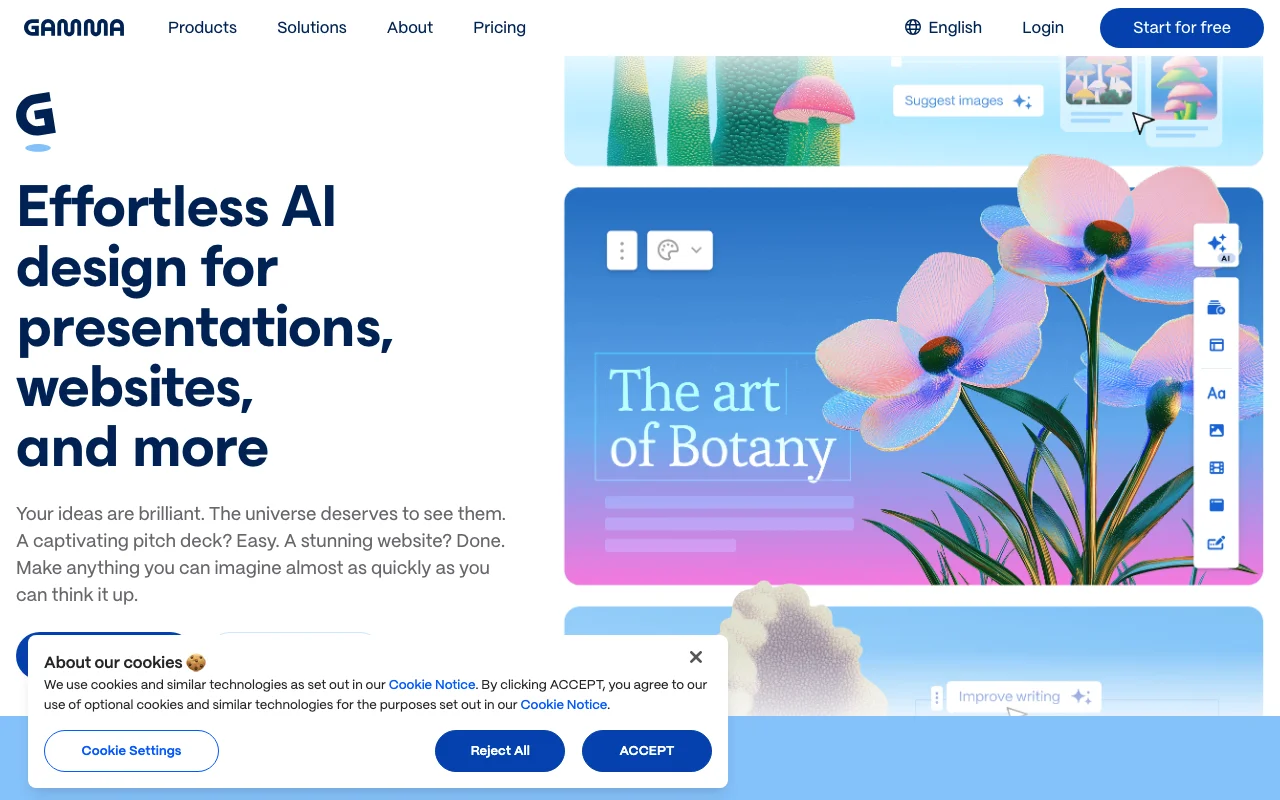
Gamma turns a prompt or outline into a polished deck, which makes it the fastest way to get a roadmap review, a quarterly plan, or a stakeholder update presentation-ready. You bring the narrative and the priorities, Gamma handles the layout and a styled first draft, and you spend your time on the message rather than on slide formatting.
A brand kit keeps decks consistent with your company's look, and analytics on higher tiers show whether stakeholders actually opened what you sent.
Key features
- AI generation of decks, docs, and sites from a prompt
- Brand kit for a consistent company look
- Per-viewer analytics on shared decks
- Large template library and flexible export
Best for
- Roadmap reviews and quarterly plans
- Stakeholder and leadership updates
- PMs who lose time to slide formatting
Pricing
- Free tier (one-time credit allotment)
- Plus from around $10/month, Pro from around $20/month
Pros
- Stakeholder-ready decks in minutes
- Analytics show whether an update was read
- Low entry cost for the value returned
Cons
- Trade-off: the credit model can run out on heavy use
- Less fine control than slide software for bespoke design
How to choose the best AI tool for product work
1) Which part of the job is the bottleneck?
If it is research synthesis, Dovetail earns its place. If it is specs and docs, anchor on Claude and Notion AI. If it is stakeholder communication, Gamma moves the slow part. Buy for the bottleneck that is actually slowing your releases, not for the whole category.
2) How much user research do you run?
A lot: Dovetail turns continuous discovery into a shared, searchable asset, which is worth the per-seat cost. Occasionally: a general assistant plus Perplexity covers it, and you can keep the synthesized decisions in a memory layer rather than a research platform.
3) Are you prototyping directly?
A real 2026 shift is PMs prototyping with coding agents instead of waiting on engineering. If that is you, pair this stack with a build tool like Claude Code or a prompt-to-app builder, and read Claude Code for product managers for the deep version. It changes how fast an idea becomes something testable.
4) Solo PM, or a product org?
Solo: lean on free tiers, one general assistant, and a memory layer so context does not reset. Org: Notion AI and Dovetail give the team shared specs and shared research, which matters more than any single model once several people touch the product.
FAQ
What is the best AI tool for product managers?
For most PMs, ChatGPT is the best all-round pick, with Claude close behind for PRD-quality writing. If your bottleneck is user research, Dovetail is the strongest specialist, and Perplexity is best for sourced market research. The honest answer is that a small stack of three or four beats any single tool.
Which AI tool is best for user research synthesis?
Dovetail. It is purpose-built to turn interviews, calls, tickets, and surveys into a searchable, taggable repository with AI summarization and pattern-finding. For occasional research, a general assistant like Claude can synthesize a handful of transcripts, but Dovetail is the choice when research is continuous and shared across a team.
Can AI write PRDs?
Yes, with your judgment in the loop. Claude and ChatGPT can draft a strong PRD from a problem statement, user research, and constraints, and Notion AI can do it inside your workspace. You still own the prioritization, the trade-offs, and the decision. AI removes the blank-page tax and the formatting time, not the thinking.
Can product managers build prototypes with AI?
Increasingly, yes. Prompt-to-app builders and coding agents let PMs turn an idea into a clickable prototype without waiting on engineering, which is one of the bigger shifts in the role in 2026. It is best for validation and conversation, not production. For the Claude Code version of this, see Claude Code for product managers.
How much should a PM spend on AI tools per month?
A solo PM stack runs about $20 to $60 a month: one general assistant (ChatGPT or Claude at $20) and free tiers for the rest. Add Dovetail (paid plans from around $15 per user) if research is continuous, and a one-time memory layer like Iwo's Second Brain so product context compounds instead of resetting.
What is an AI second brain for a product manager?
It is a structured memory system that lets an AI assistant recall your product decisions, research, and release history across time. Where a research tool like Dovetail holds the raw studies, a second brain holds the decisions they led to and why. Iwo's Second Brain is one way to build it, covered in the AI second brain guide.
Will AI replace product managers?
No, but it changes the job. AI absorbs the synthesis, drafting, and formatting that fill a PM's week, which frees more time for the parts it cannot do: talking to users, aligning stakeholders, and making the call on what to build. The PMs who thrive treat these tools as leverage on their judgment, not a replacement for it.
Want your product decisions and research to compound instead of reset each release? See Iwo's Second Brain for the structured system, and Iwo's MemoryOS for the memory layer that works with any AI client. For the bigger picture, read the AI second brain guide.