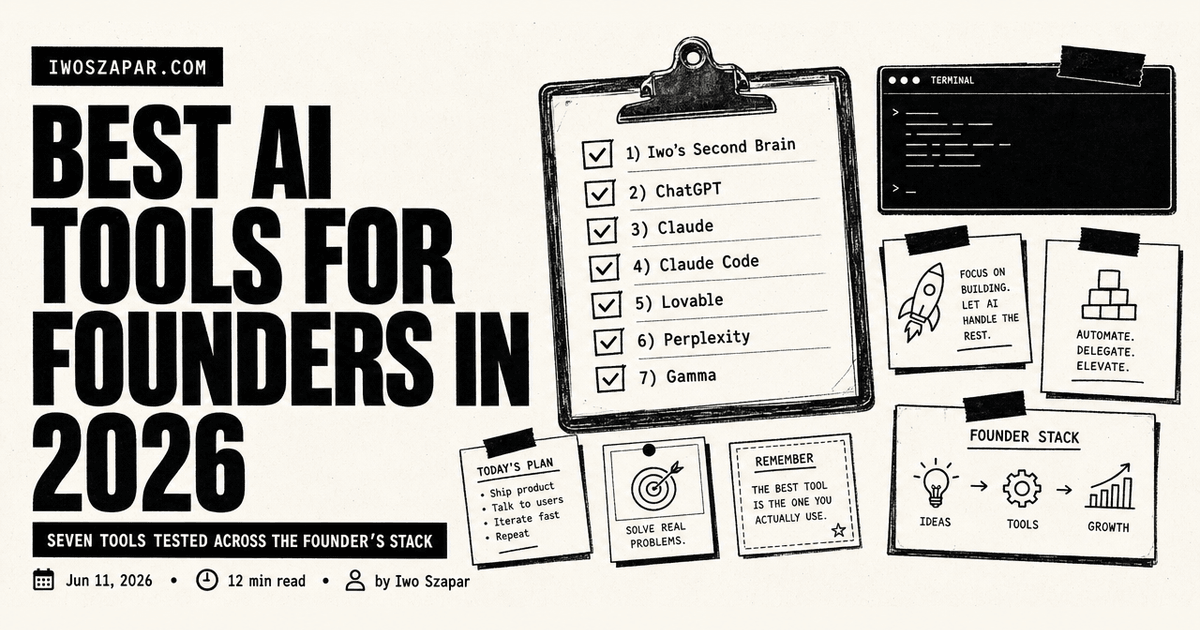
Best AI tools for founders in 2026
Seven tools tested across the founder's stack
A founder's job is to do the work of a ten-person team before there is a ten-person team. AI is how that math starts to work. The hard part is not finding tools. It is finding the few that genuinely move a stage of the company forward instead of becoming another subscription you forget to cancel.
This guide covers seven AI tools tested across the founder's real stack: building the product, researching the market, writing the pitch, running calls, and keeping the knowledge that holds it all together. Each entry has honest pros, real trade-offs, current pricing, and a clear sense of who it fits. Pricing is current as of mid-2026 and moves often, so confirm before you commit.
Disclosure: Iwo is the maker of Second Brain and MemoryOS, and they sit at number one here. They are our own products, so read this as a recommendation with skin in the game. We put them first because memory is the one job they do better than a general assistant, persistent company memory that compounds as the company moves, the thing the other tools assume but do not give you, with honest cons noted. The rest of the list is ranked on merit, with honest cons kept, and one of those tools may matter more for the bottleneck in front of you today.
Best AI tools for founders: a brief overview
If you want the company's knowledge to compound:
- Iwo's Second Brain for the memory foundation that remembers every decision and lesson the company makes
If you are building the product:
- Claude Code for turning ideas into shipped code in your terminal or IDE
- Lovable for spinning up a working MVP or landing page from a chat
If you are running the company:
- ChatGPT for the broadest everyday assistant
- Claude for reasoning, long documents, and careful writing
- Perplexity for market and competitor research with citations
- Gamma for pitch decks and investor updates
| Tool | Key strength | Pricing | Best for |
|---|---|---|---|
| Iwo's Second Brain | Structured company memory | $197 DIY / $597 Kickstart (one-time) | Founders who reuse knowledge |
| ChatGPT | Broadest everyday assistant | Free; Plus $20/mo | General founder work |
| Claude | Reasoning and long-document writing | Free; Pro $20/mo | Strategy and writing |
| Claude Code | Agentic coding in your terminal | In Claude Pro $20/mo and up | Technical and solo founders |
| Lovable | Prompt-to-app MVPs | Free; Pro $25/mo | Non-technical builders |
| Perplexity | Cited market research | Free; Pro $20/mo | Market and competitor scans |
| Gamma | AI pitch decks, fast | Free; Plus from ~$10/mo | Investor and sales decks |
1. Iwo's Second Brain, best overall for company memory that compounds
A startup forgets things at speed: why you priced the way you did, what that investor actually said, which experiment already failed. Iwo's Second Brain is a structured memory layer, a folder system plus skills plus an MCP integration with Iwo's MemoryOS, that lets an AI assistant recall the decisions and lessons a fast-moving company leaves behind. This is our own product, which is why we start with it: every other tool in this list works better when the company's memory is in place underneath it.
The differentiator is typed memory surfaces. Decisions, facts, open loops, and company state each live in their own surface and get retrieved on purpose, not by fuzzy search. Ask what you decided about pricing last quarter and the system returns the decision record. For a founder building a company largely solo, it is the closest thing to an institutional memory you do not have yet. See how one founder runs a lean business on systems for the broader pattern.
Key features
- Typed memory surfaces (decisions, facts, open loops, company state)
- Recall scoring with confidence and freshness signals
- MCP-native, works with Claude, Claude Desktop, and Cursor
- One-time packaging tiers, no monthly subscription
Best for
- Founders running mostly solo who need an institutional memory
- Operators who tried several note systems and abandoned each
- People who want their memory layer inspectable
Pricing
- DIY $197 one-time (template and setup guide)
- Kickstart $597 one-time (template plus a guided build)
Pros
- Recall scoring lets you verify what the AI is grounding on
- One-time pricing with no recurring fee
- Pairs cleanly with Iwo's MemoryOS
Cons
- Trade-off: more setup upfront in exchange for a structured system
- Best fit for people comfortable with markdown and the terminal
- A smaller community than the big note-app ecosystems
2. ChatGPT, best all-round assistant for founders
ChatGPT is the founder's Swiss army knife. In a single day it can draft a hiring post, sanity-check a pricing model, rewrite a cold email, summarize a contract, and brainstorm a positioning angle. When you are wearing every hat, the tool that does a little of everything is the one you open most.
The 2026 version runs on the GPT-5 model family with reasoning, web browsing, data analysis, and image generation. Custom GPTs let you save the prompts you reuse, like an investor-update template or a brand voice, so the company's repeatable thinking lives somewhere instead of being retyped.
Key features
- GPT-5 model family with reasoning and deep research modes
- Data analysis, file upload, web browsing, image generation
- Custom GPTs for repeatable founder workflows
- Memory across chats
Best for
- Founders who want one assistant for the whole grab bag of daily work
- Early teams without specialists for every function
- Anyone replacing several point tools with one
Pricing
- Free tier (ad-supported in the US, capped on the strongest model)
- Plus $20/month, with higher-usage Pro tiers above it
Pros
- Covers the widest range of founder tasks in one place
- Huge ecosystem of integrations and custom GPTs
- Familiar to most of your team and advisors
Cons
- Trade-off: the free tier shows ads and throttles the best model
- For deep coding or sourced research, a specialist tool does better
3. Claude, best for strategy, writing, and long documents
Claude is the founder's tool for the work that needs to be right, not just fast. It reasons carefully across long inputs, which makes it strong for strategy memos, investor updates, board prep, and reading a contract or data room end to end. Its writing reads finished, so the output of a late-night drafting session needs less morning cleanup.
Current Claude models carry very large context windows, so you can hand it a full deck, a long thread, or a messy founder brain-dump and ask questions across all of it. Projects keep each workstream's context in one place.
Key features
- Strong reasoning and writing quality
- Very large context window for long documents
- Projects and Artifacts to organize workstreams
- Web search and file creation
Best for
- Strategy, fundraising, and board-facing writing
- Reading and questioning long documents
- Founders who want output that needs less editing
Pricing
- Free tier
- Pro $20/month, with Max tiers from $100/month for heavy use
Pros
- Finished-feeling output for high-stakes writing
- Long context handles whole documents without chunking
- Calibrated and careful, which suits investor-facing work
Cons
- Trade-off: a smaller plugin ecosystem than ChatGPT
- Max tiers are priced for heavy users
4. Claude Code, best for building the product
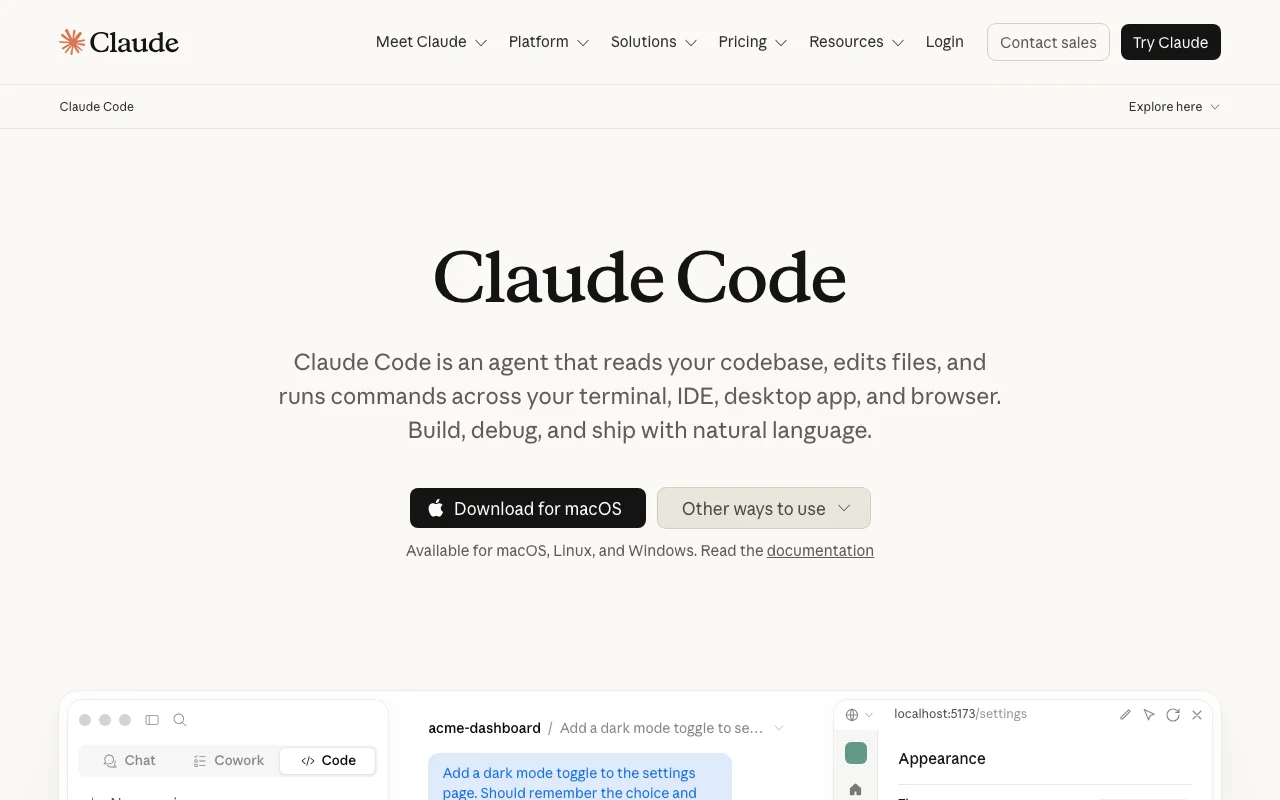
Claude Code is Anthropic's agentic coding tool, and for technical and solo founders it is close to a force multiplier. It reads your whole codebase, plans multi-step changes, runs commands, and edits across files from your terminal or IDE. Founders use it to ship features, fix bugs, and prototype faster than a small team could, without losing control of what lands.
It works where developers already work (terminal, VS Code, JetBrains) and connects to MCP servers, so it can reach your real tools rather than guessing. For founders who can code even a little, it raises the ceiling of what one person can build. If you are starting out, the Claude Code 101 guide for knowledge workers is a gentle on-ramp.
Key features
- Agentic understanding of a whole codebase
- Multi-file edits, command running, and issue-to-PR flows
- Terminal, IDE, Slack, and web surfaces
- Works with MCP servers and subagents
Best for
- Technical and solo founders building the product
- Shipping features and fixes without a full eng team
- Founders comfortable in a terminal or IDE
Pricing
- No standalone plan, bundled into Claude Pro ($20/month) and Max ($100/month and up)
- Also usable pay-as-you-go via the Anthropic API
Pros
- Best-in-class for autonomous, real-codebase coding
- Meets you in your existing dev workflow
- Turns ideas into shipped code quickly
Cons
- Trade-off: it expects comfort with a developer workflow
- Heavy agentic sessions consume usage faster
5. Lovable, best for shipping an MVP without code
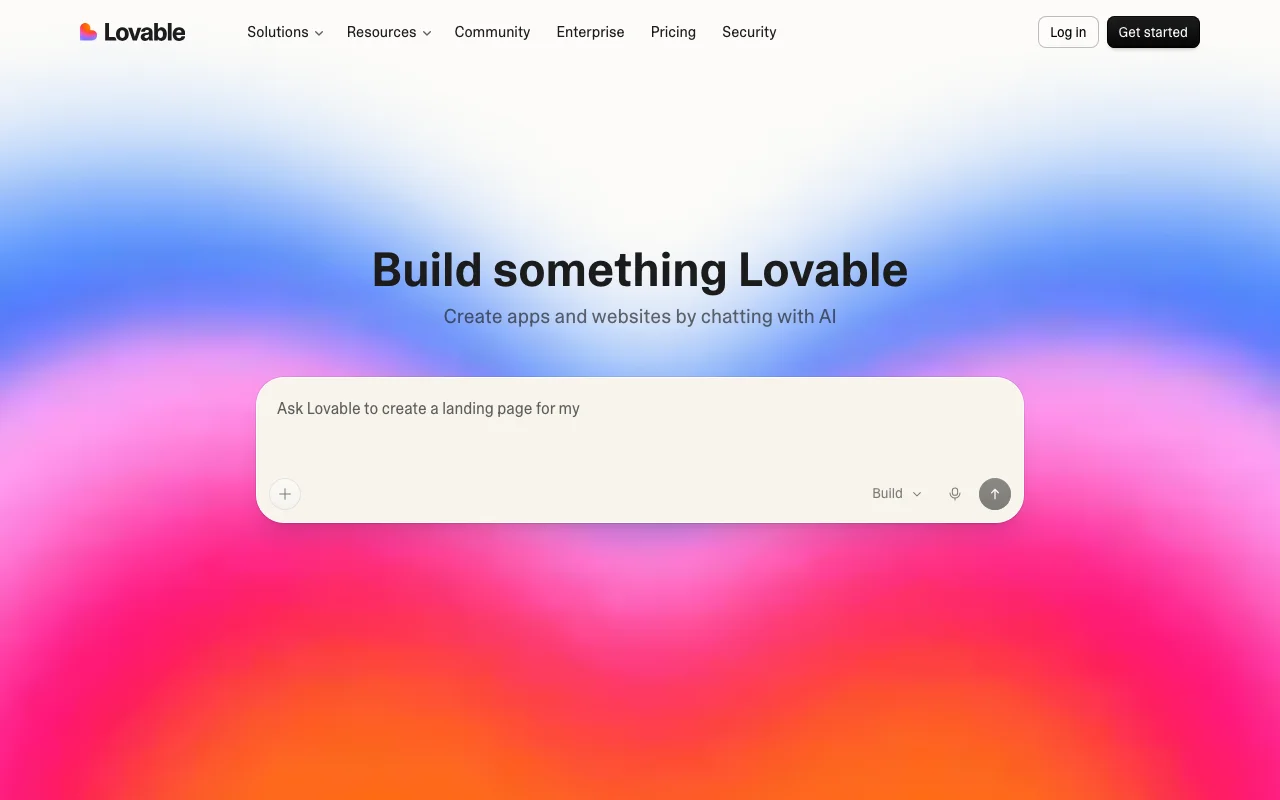
Lovable is for the founder who can see the product but cannot build it. You describe the app in a chat, and Lovable generates a working full-stack web app, frontend and backend, with a real database, auth, and storage through its Supabase integration. It is the fastest path from idea to something a user can actually click.
For validating a concept, building a landing page, or putting a prototype in front of customers before hiring an engineer, it collapses weeks into an afternoon. The trade-off to watch is cost: there is a usage layer on top of the subscription, so a heavy build can burn more than the sticker price suggests. The broader shift is covered in vibe coding, when software writes itself.
Key features
- Prompt-to-app generation, frontend and backend
- Full Supabase integration (database, auth, storage)
- Custom domains and project sharing
- Agent mode for larger edits
Best for
- Non-technical founders building an MVP
- Fast validation and landing pages
- Prototypes to test before hiring engineering
Pricing
- Free tier (limited daily credits)
- Pro $25/month, plus a usage layer for what shipped apps consume
Pros
- Idea to working app in minutes, with a real backend
- Lets a non-technical founder validate without engineering
- Great for MVPs, prototypes, and landing pages
Cons
- Trade-off: dual-layer billing makes total cost less predictable
- Complex or production-scale apps can outgrow it
6. Perplexity, best for market and competitor research
Perplexity answers research questions and cites its sources, which is exactly what a founder needs when sizing a market, scoping competitors, or prepping for a fundraise. Instead of opening fifteen tabs, you ask, and you get a synthesized answer with links you can check before you build a slide on top of it.
Its Research mode runs deeper multi-step investigations, and the paid plan gives you several frontier models in one place. For the constant stream of "is this true and how big is it" questions a founder faces, it is faster than doing the reading yourself.
Key features
- Cited answers with linked sources
- Deep Research mode for sourced market briefs
- Access to multiple frontier models on Pro
- File upload and focused search
Best for
- Market sizing and competitive research
- Fundraise and investor-question prep
- Founders who need defensible facts fast
Pricing
- Free tier
- Pro $20/month (or around $200/year)
Pros
- Citations make research defensible to investors
- Much faster than manual searching
- One Pro plan spans several models
Cons
- Trade-off: weaker at long-form generation than ChatGPT or Claude
- The top tier is more than most founders need
7. Gamma, best for pitch decks and investor updates
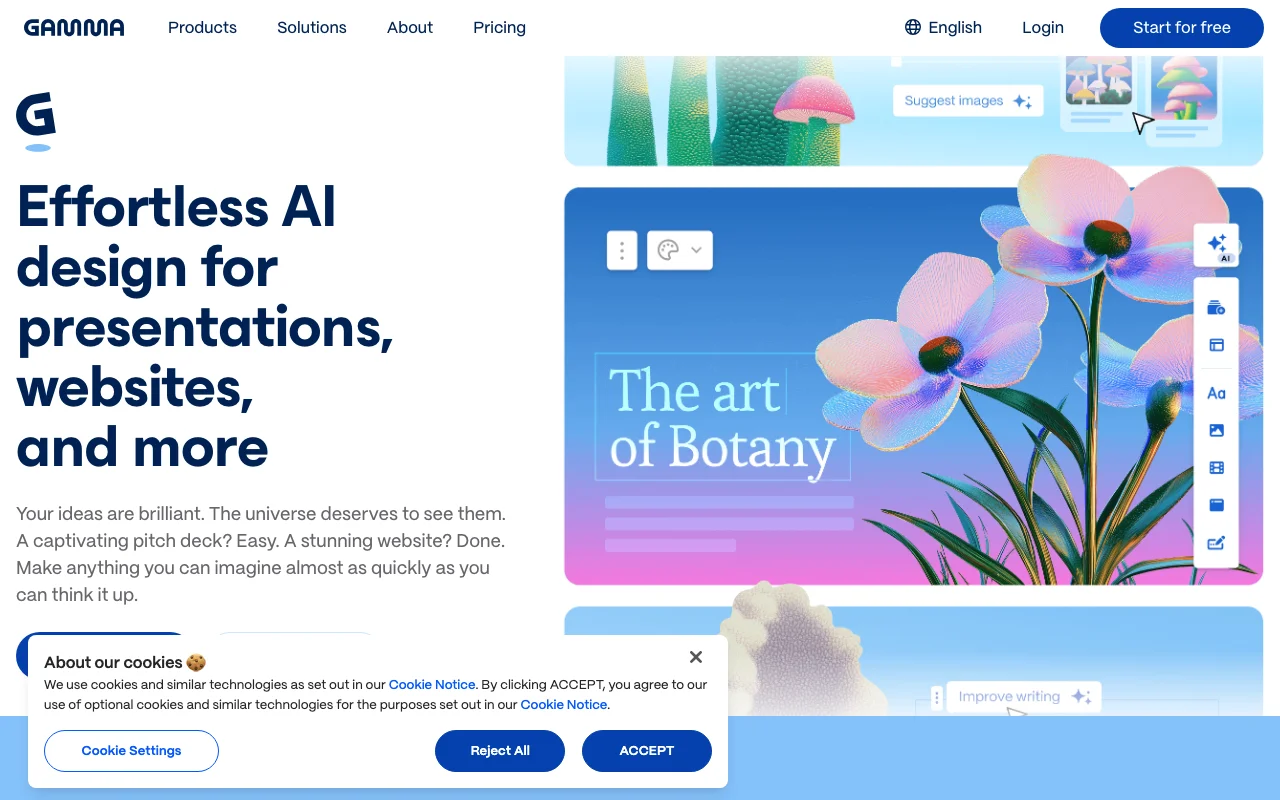
Gamma turns a prompt or outline into a polished deck, doc, or microsite, which makes it the fastest way to get a pitch or an investor update out the door. You bring the story and the numbers, Gamma handles the layout and the first styled draft, and you spend your time on the narrative rather than on slide masters.
A brand kit keeps your decks consistent, and per-viewer analytics on higher tiers show whether an investor actually opened the deck you sent, which is useful signal during a raise.
Key features
- AI generation of decks, docs, and sites from a prompt
- Brand kit for a consistent investor-facing look
- Per-viewer analytics on shared decks
- Large template library and flexible export
Best for
- Pitch decks and investor updates
- Sales and customer-facing materials
- Founders who lose time to slide formatting
Pricing
- Free tier (one-time credit allotment)
- Plus from around $10/month, Pro from around $20/month
Pros
- Investor-ready decks in minutes
- Analytics show whether a deck was opened
- Low entry cost for the value returned
Cons
- Trade-off: the credit model can run out on heavy use
- Less fine control than slide software for bespoke design
How to choose the best AI tool for your startup
1) What stage are you actually stuck at?
If you are stuck on building, start with Claude Code (if you can code) or Lovable (if you cannot). If you are stuck on selling and raising, Gamma plus Perplexity moves the pitch and the research. Buy for the bottleneck in front of you, not the whole list at once.
2) Can you code, even a little?
This one question splits the build stack. Yes: Claude Code gives you the highest ceiling and the most control. No: Lovable gets you a working app without an engineer, with the cost caveat to watch. Many founders use both, prototyping in Lovable and graduating the serious parts into a real codebase with Claude Code. The broader idea is in vibe working, AI without coding.
3) Solo, or an early team?
Solo: a couple of paid seats and a memory layer go a long way. Early team: add a shared workspace and make sure the company's decisions live somewhere durable, because the cost of forgetting compounds faster than any tool's subscription.
4) What compounds versus what you rent?
Most of these are monthly tools you rent for a stage. The exception is Iwo's Second Brain, a one-time memory layer built to compound: every decision and lesson you run through it makes the next one cheaper to recall. For a founder, an institutional memory you actually own is worth more than one more subscription. See what is coming in you will have an AI agent this year.
FAQ
What is the best AI tool for founders?
There is no single winner, because founders work across building, selling, and running. ChatGPT is the best all-round starting point, Claude Code or Lovable is best for building the product, and Perplexity is best for research. Most founders run a small stack of three or four rather than betting on one tool.
What AI tools can a non-technical founder use to build a product?
Lovable is the strongest pick. You describe the app in a chat and it generates a working full-stack web app with a real backend, so you can validate an idea or ship a landing page without an engineer. Watch the usage-based billing on heavier builds, and plan to move the serious parts into a real codebase as you grow.
How much should a founder spend on AI tools per month?
A lean founder stack runs about $40 to $80 a month: one general assistant (ChatGPT or Claude at $20), a build tool (Claude Code in a Claude plan, or Lovable at $25), and free tiers for the rest. Add a one-time memory layer like Iwo's Second Brain so the company's knowledge compounds instead of resetting.
Is AI good enough to replace hiring early employees?
It changes when and who you hire, not whether you hire, and whether AI creates more jobs than it removes is the debate underneath that shift. AI lets a founder go further before the first engineer, designer, or analyst, which extends runway and sharpens what the first hires should focus on. It does not replace ownership, relationships, or judgment. The founders who win use it to stay small longer on purpose.
Which AI tool is best for pitch decks?
Gamma. It generates a styled deck from a prompt or outline in minutes and keeps a consistent brand look, and its analytics show whether an investor opened it. You still own the story and the numbers, but the formatting and first draft are handled.
What is an AI second brain, and does a founder need one?
An AI second brain is a structured memory system that lets an AI assistant recall your decisions, lessons, and company context across time. For a founder building largely solo, it is the institutional memory a young company does not have yet. Iwo's Second Brain is one way to build it, and the AI second brain guide covers the concept in depth.
Do these tools handle confidential or investor information safely?
It depends on the tool and tier. Paid and enterprise plans usually offer data controls and opt-outs from model training, while free tiers often do not. Keep cap-table, financial, and contract details out of consumer tiers, and review each tool's data terms before you rely on it.
Want your company's knowledge to compound instead of reset? See Iwo's Second Brain for the structured system, and Iwo's MemoryOS for the memory layer that works with any AI client. For the bigger picture, read the AI second brain guide.