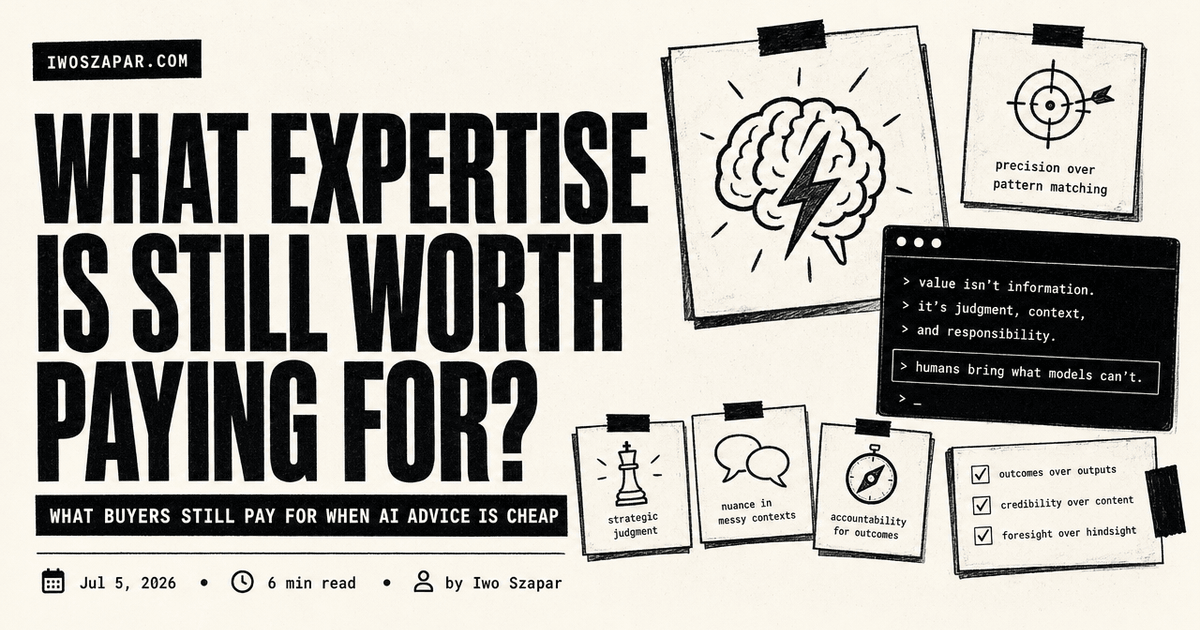
What Expertise Is Still Worth Paying For?
When AI can produce competent advice on almost anything, what still makes a human expert worth paying?
Most advice is about to become too cheap to sell.
That sounds harsh, but I don’t mean expertise is dead. I mean the old deal around expertise is breaking.
I'm writing this because I'm collecting field notes for a short whitepaper. My current hypothesis is below, but I want it pressure-tested by people seeing this shift inside their own work.
The old deal
For a long time, the buyer question was simple:
Old question: “Can you teach me this?”
That question created a huge market for courses, templates, newsletters, playbooks, workshops, and advisory content. If you knew something valuable and could explain it well, people paid you for access.
That deal worked because access was scarce.
Now access is abundant. AI can explain most topics in plain English. It can summarize books, compare options, draft plans, create checklists, write prompts, critique decisions, and produce advice that is often good enough to start with.
Not perfect. Not always right. But competent.
And competent advice changes the buyer’s expectations.
The buyer shift
The new question is sharper:
New question: “Can you help me decide, execute, or get unstuck in my actual context?”
That shift feels more useful than another abstract debate about “what happens to expertise.” Buyers still pay for experts. They just get less excited about paying for information alone.
They pay when the expert helps them move through mess.
The scarce thing is no longer information. It is judgment in context.
A founder doesn’t only need “AI strategy.” She needs someone to look at her actual week and say: don’t build a chatbot first. Build the morning overview that reads your calendar, inbox, pipeline, and goals, then gives you the three things that matter today.
That is what I mean by executable expertise. Not another explanation of AI. A working rhythm like an AI Daily Overview.
A consultant doesn’t only need a prompt pack. He needs his sales context, proposal style, client notes, objections, and follow-up rules built into the system so AI can help him produce better work without starting from zero each time.
That is closer to context engineering: designing what the AI knows, what it remembers, what tools it can access, and which rules it must follow.
A team doesn’t only need “agents.” They need a loop that can do the work, check the result, retry when something fails, and stop before it creates damage.
That is the point of loop engineering. The value is not “AI can act.” The value is knowing what counts as done before the AI starts moving.
What experts actually do
My current guess is that the premium moves from advice to judgment, context, and execution.
In AI implementation, the expert often does five concrete things:
- Diagnose the real blocker. Is the problem the model, the missing context, the messy data, the weak process, or the lack of review? A diagnostic like the Second Brain Setup Health Check turns vague frustration into a map.
- Choose the first workflow. Not the most impressive one. The one that will survive contact with the buyer’s real day.
- Design the context. What should the AI know about the person, company, clients, goals, rules, and style?
- Design the loop. What should the AI do, what should it check, when should it retry, and when should it stop?
- Place the human. Some decisions should be automated. Some should be drafted. Some should stay human.
That work is hard to buy as “information.” It is much easier to buy as implementation.
My current rough map
My current rough map is practical, and incomplete.
Judgment under uncertainty. AI can list options. A strong expert can say, “Given your team, budget, data, and risk, start here.”
Taste and prioritization. Many AI use cases sound good. Few deserve the next 30 days.
Lived pattern recognition. Experts notice the failure mode early. After building 108 Second Brain setups, the patterns became obvious: the terminal was a wall, long questionnaires killed momentum, documentation-only onboarding failed, and maintenance loops did not maintain themselves.
Trust and accountability. Advice from AI has no skin in the game. A human expert can stand behind a recommendation and help the buyer stay with a hard choice.
Domain-specific context. Generic guidance breaks when it meets a messy company, a strange market, a political team, a regulated industry, or a founder with very specific constraints.
Implementation systems. Many people know what to do. Fewer have a reliable way to make it happen. This is where workflows like the AI Work Cycle matter: plan, work, review, triage, learn. Not as theory. As operating rhythm.
Reputation and decision confidence. Buyers often pay to reduce regret. They want to know that a serious person has looked at the problem and helped them choose with more confidence.
From content to executable expertise
This also changes what experts should build.
For years, the default move was to publish more content:
- More posts.
- More newsletters.
- More videos.
- More free advice to prove you know your stuff.
That still works as a trust signal. But it may not be enough as a product.
The next premium product may not be more content. It may be an executable version of your expertise.
The experts who win may not be the ones who publish the most content. They may be the ones who can turn their method into something usable: a workflow, diagnostic, agent, playbook, review loop, or operating system for a specific buyer.
A leadership coach could turn their method into a weekly decision review agent. A sales expert could turn their process into a prospect research and follow-up loop. A finance expert could create a monthly close workflow that gathers documents, flags missing items, drafts explanations, and prepares the human review.
A lot of experts have valuable judgment trapped in calls, docs, voice notes, private feedback, messy spreadsheets, and patterns they’ve never written down. AI makes it possible to package some of that into tools that help buyers act, not just learn.
A course says, “Understand this.”
An executable system says, “Bring me your messy situation, and I’ll help you make the next decision.”
That feels like a more durable direction.
The question
I’m less interested in predictions about “AI replacing experts” and more interested in the buying question: what would you still pay for?
My hypothesis is simple: people will keep paying experts when the expert changes the buyer’s odds in a real situation.
The value comes from helping them choose, adapt, execute, and trust the next step.
Send me your take: I’m collecting perspectives for a short whitepaper. Send me your field and one thing people will still pay a human expert for, even when AI gives competent advice.
Especially interested in concrete examples: what becomes more valuable, not less? What becomes hard to copy?